Drawing Primarily: Creighton Michael
a brief and annotated history of my relationship with drawing
Part 4 A
exploring the digital landscape
In the mid 1970’s, my association with video was ½” reel to reel, which my professor, Howard Jones, and I used mostly to document artist and their work for an information exchange between art schools and departments across the country. Known as The Video Dialogue Network, it would become obsolete with the expansion of the internet. Thirty years later, I would revisit video as a tool for documentation, but this time it would be my drawing activity that would be used to add historical context as an integral part of my developing work. Through this process, I began to see distinct components of drawing, one of which is a marking episode or “doodle”. Later in a sculpture series like Rhapsody these “episodes” would be seen as individual marking units that could be used to construct a drawing. Video’s purpose would shift from simply documenting process to becoming a lighting source containing an historical context of my previous activity as well as opening new pathways for exploration.
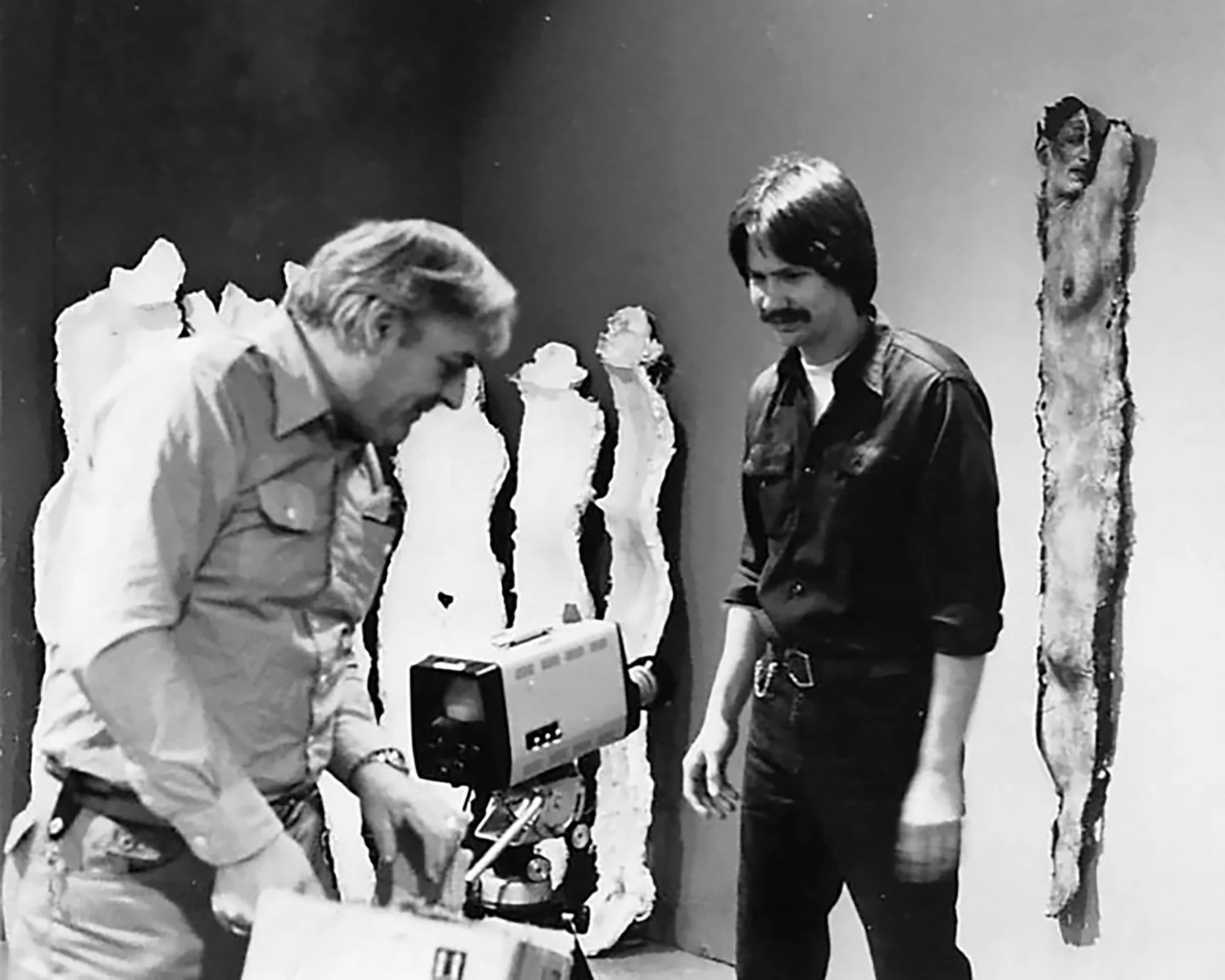
Howard Jones and I filming the work of Jon Palmer, a California sculptor, who in 1977, was a visiting artist at Washington University in St. Louis.
With the guidance of Paninat Roper, one of the interns that stayed and became my studio assistant, I returned to video, which had changed from analog to digital. This time I was documenting my marking activity, which would lead to using other digital devices such as a scanner. Quickly, I learned that a scanner could capture not only current marking activity, but also past episodes as well. This opened to new directions for self-discovery, expanding my practice in ways never imaged.
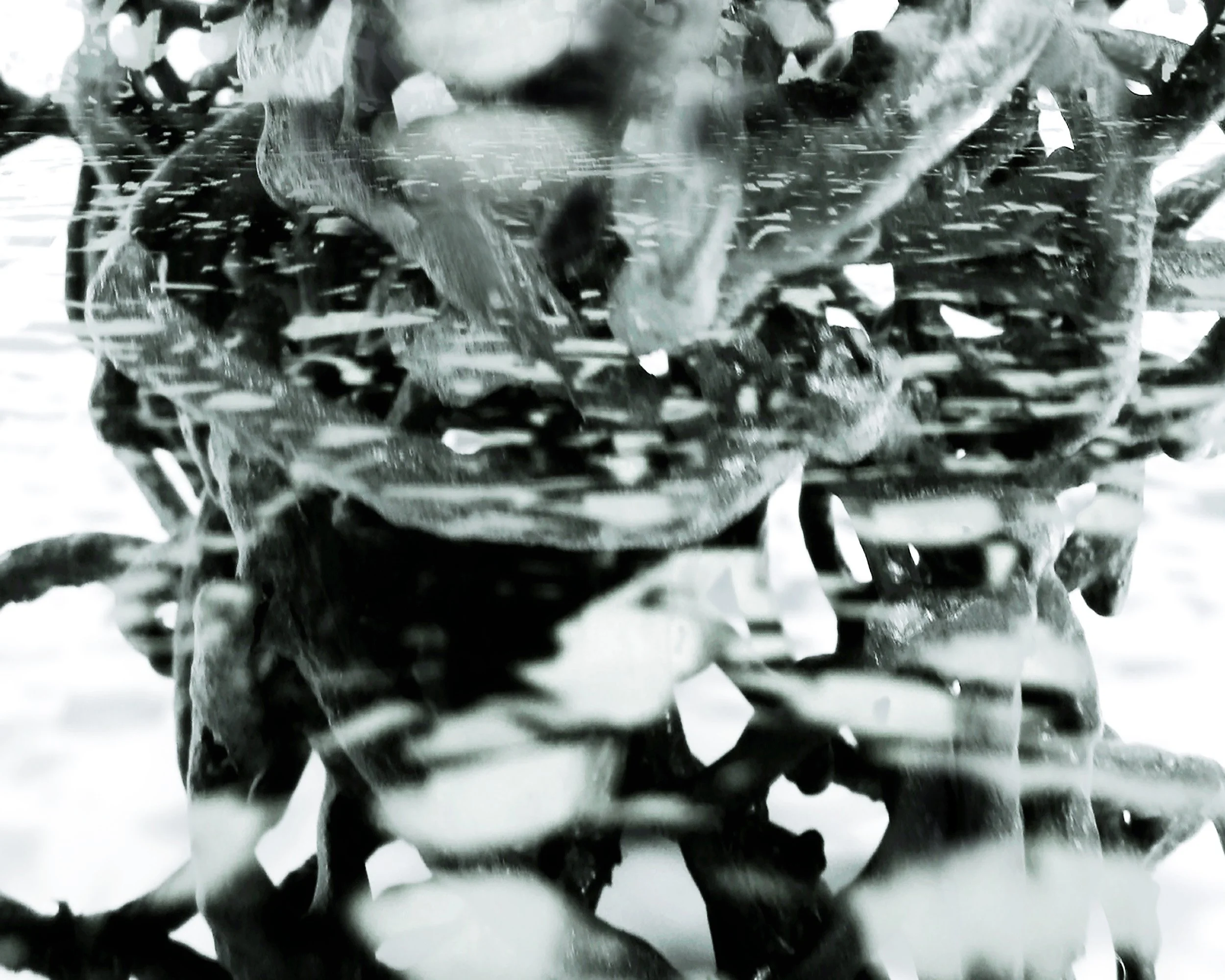
By 2010, my exploration of drawing through and by digital means would follow varied but related routes shown either in video, or as drawing panels, or prints.
The first series of in this new category called digital drawing was Tapestry, developed by coalescing various marking episodes from different moments and disciplines within my practice into a single image. Former etching plates, 35mm slides of analog drawings, video stills capturing marking activity, and patterns produced by digitally redrawing and erasing documented three-dimensional work, combine to create a new direction in my practice.
Tapestry 3610, 2010. Archival pigment print, 18 x 24”.
Tapestry 4810, 2010. Archival pigment print, 14 x 10”.
Tapestry 1710, 2010. Archival pigment print, 20 x 16”.
Capturing sequential gestures produced the imagery in both the Orchid and Reverie series of digital drawings. Remnants from my current sculpture practice, such graphite coated rope segments and dried acrylic puddles were used as drawing tools. Instead of implying movement, the arrested action suggests a moment of fragile solitude.
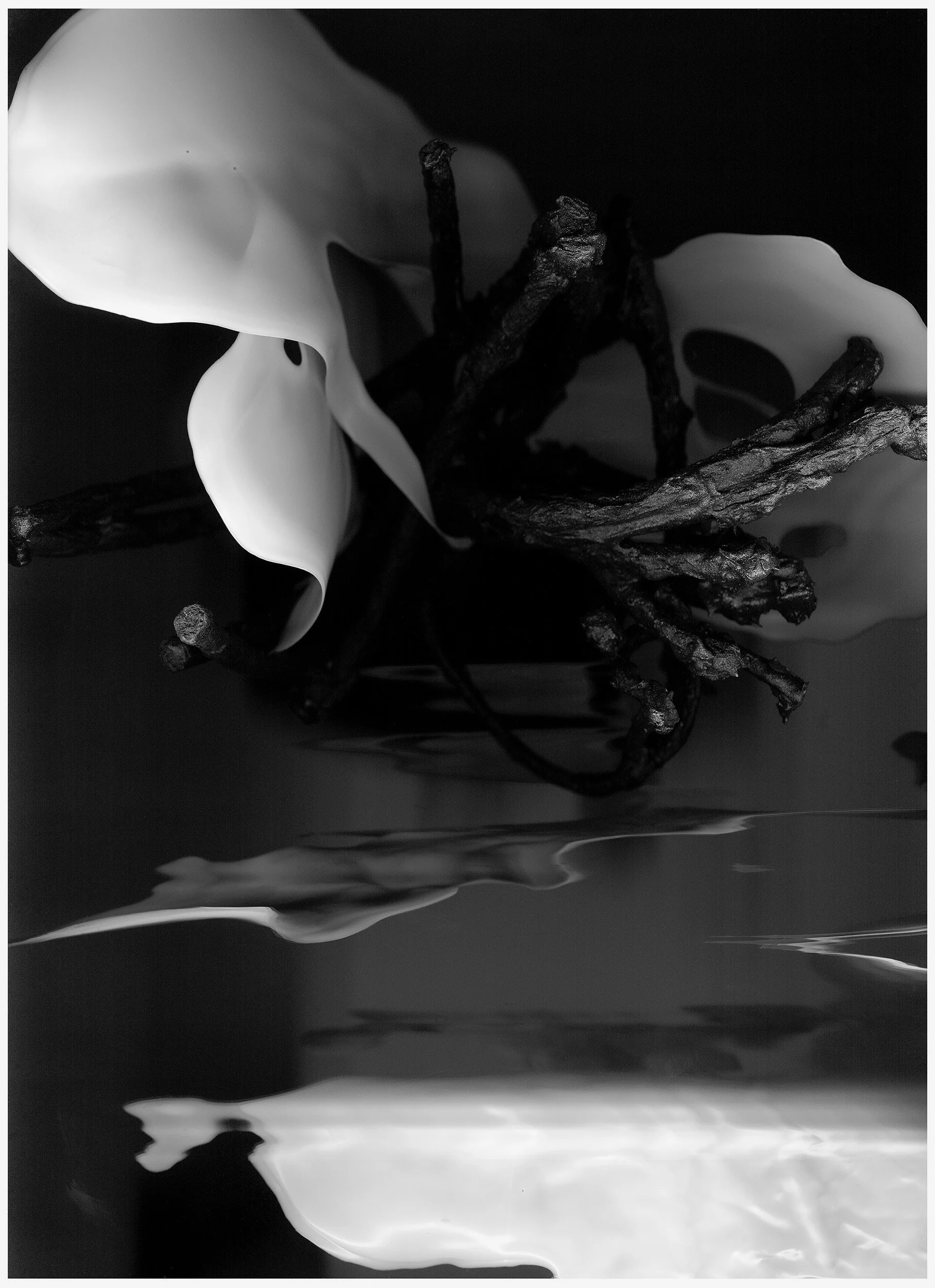
Orchid 9911 A.P., 2011. Archival carbon pigment print, 36 x 26” image size on 40 x 30”.

Reverie 8611 A.P., 2011. Archival carbon pigment print, 36 x 26” image size on 40 x 30”. Private collection, Philadelphia, Pennsylvania.
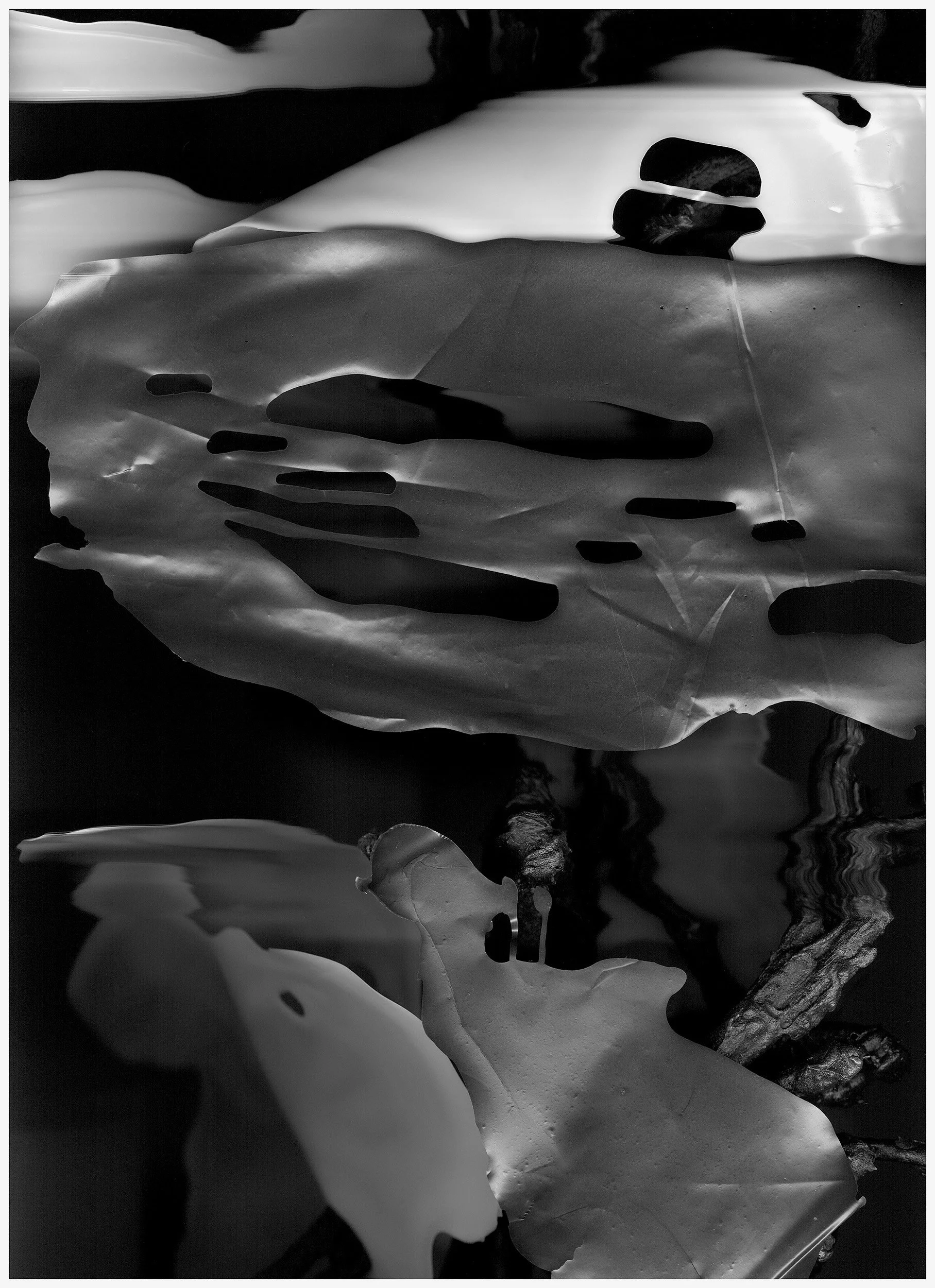
Orchid 11111 A.P., 2011. Archival carbon pigment print, 36 x 26” image size on 40 x 30”.
Three other series that used a motion capture process with debris from my sculpture practice as drawing tools were Phantasm, Idiom and Lace. They along with other explorations in digital drawing produced as prints on paper or plexiglass continues in “part four-b: exploring the digital landscape”
Idiom 311 A.P., 2011. Archival carbon pigment print, 18 x 50” image size on 22 x 54”.
Captured on video, the redistribution of marking episodes are interpreted as an act of drawing.
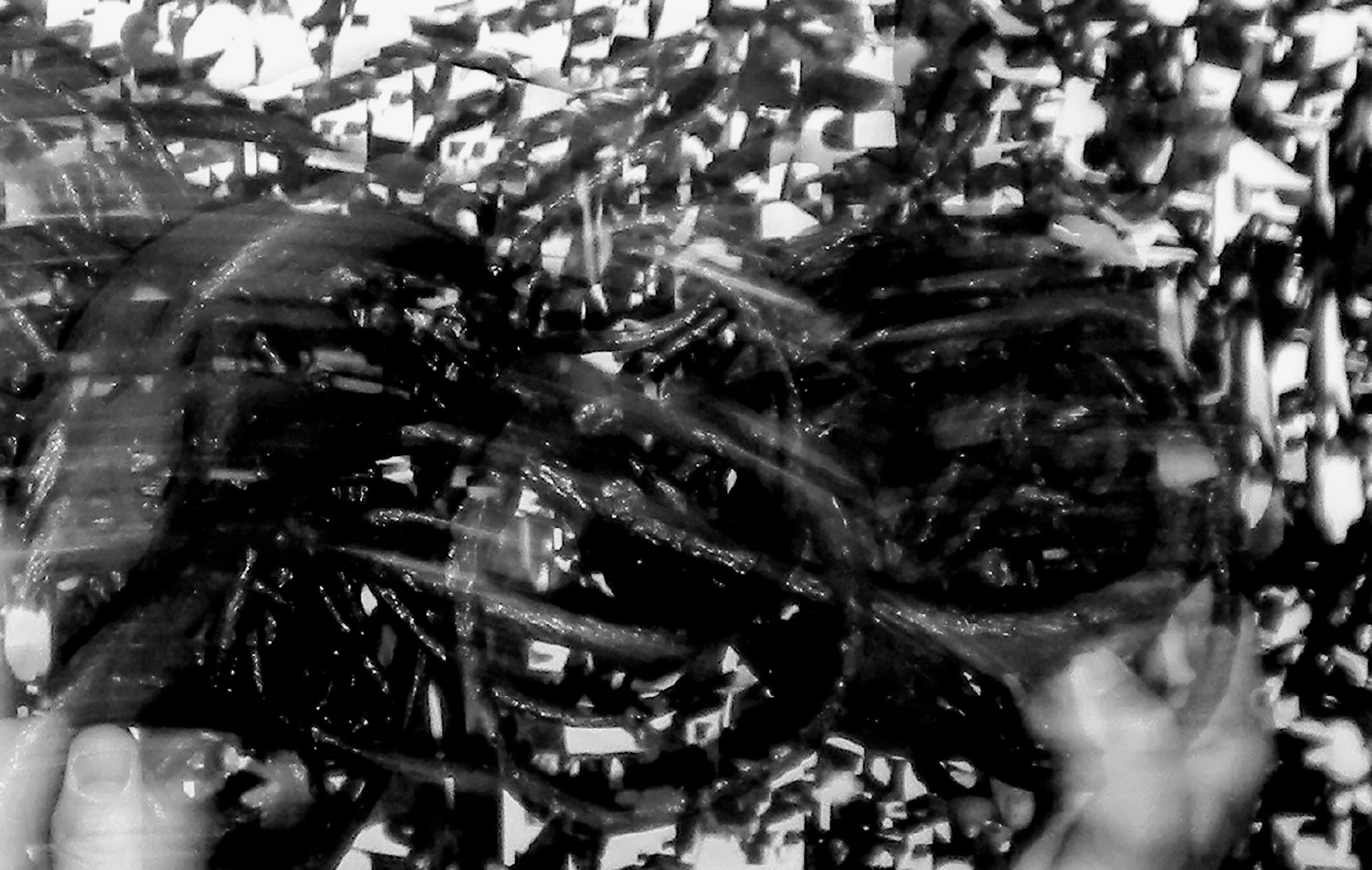
Black Tapestry, 2010. Video stills. Paninat Roper, camera and editor.
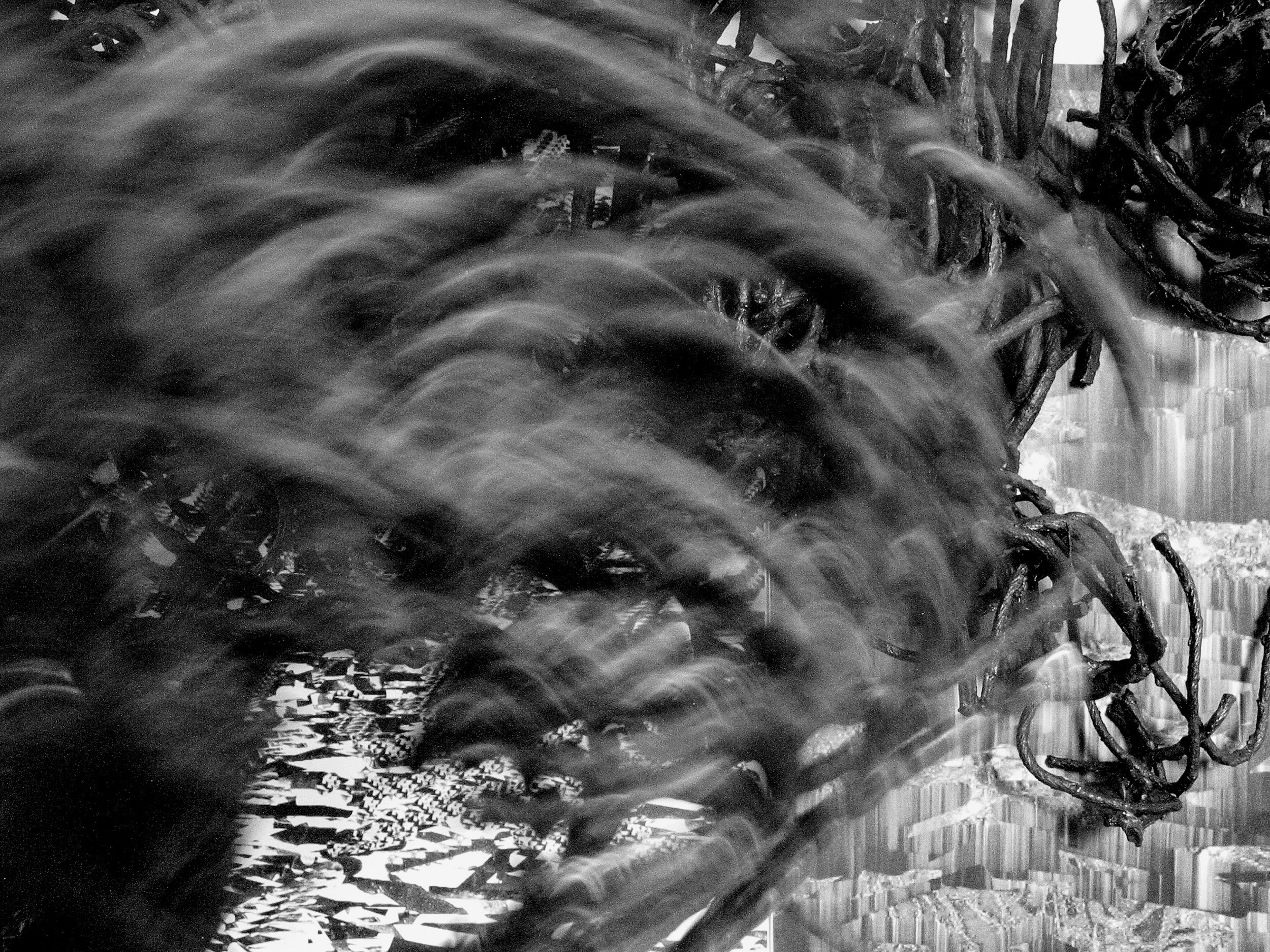
Initially video was used to capture and record marking activity. It was subsequently employed as the lighting source for the installations such as Filament and Drawing Curtain. Realizing its potential for the further exploration of marking systems including those which incorporate sound, I produced two drawing videos, Shadows Trilogy and Double Dutch: The Wedding Feast.
An interaction between light and line, Filament combines the sequenced light simulations of Bill FitzGibbons with Creighton Michael’s fiber drawing creating an environment, in which the viewer encounters the tangible nature and intimacy of drawing. As the primary light source, a collaged video of both artists captured in various drawing activities, Filament fuses the viewer’s participation in real time with the artists’ historical marking pursuits.
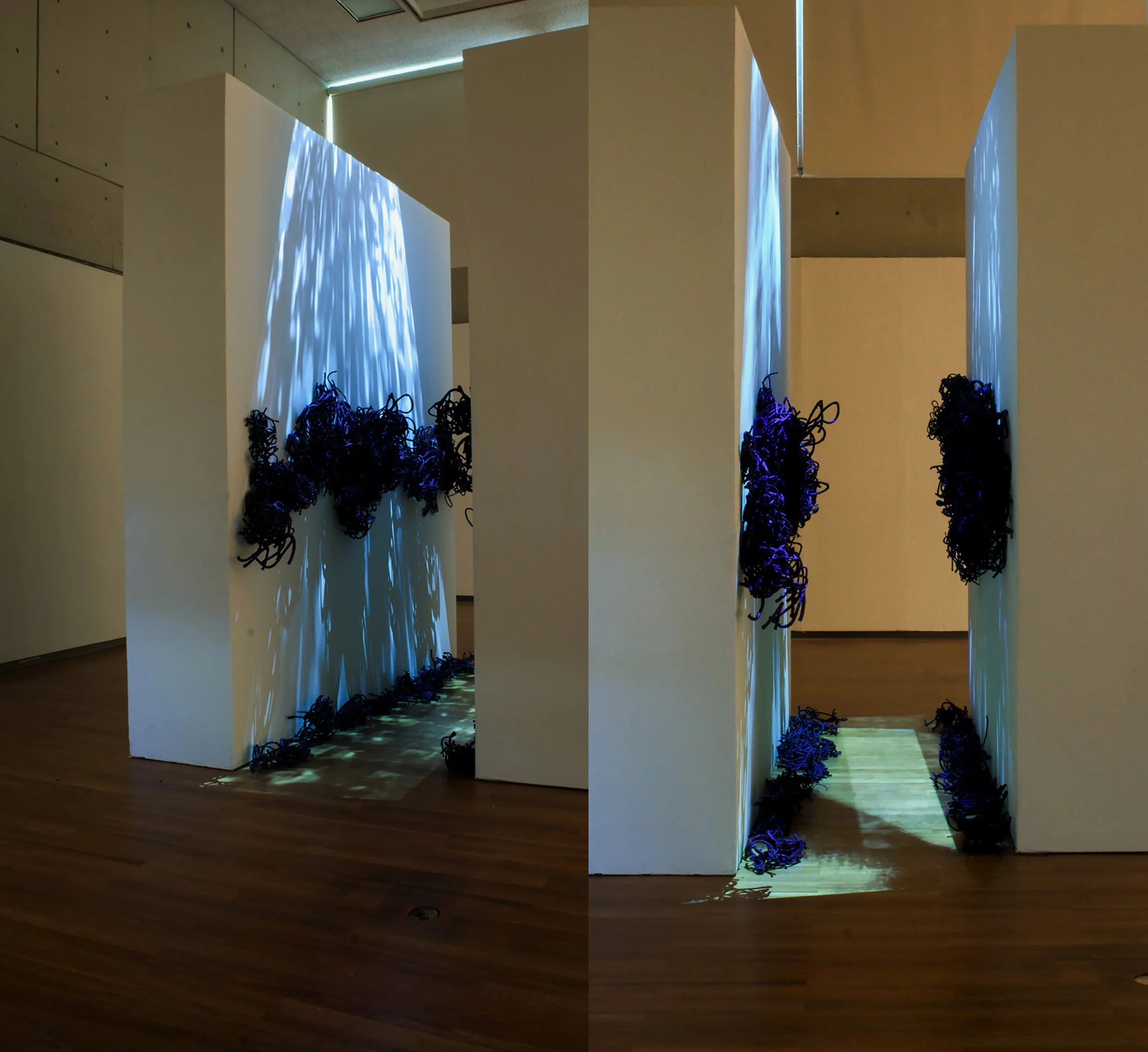
Filament: The Work of Bill FitzGibbons and Creighton Michael, 2010. Installation view with two perspectives. Ewing Gallery, University of Tennessee, Knoxville, Tennessee.
Drawing Curtain, 2011. Charcoal- and paper-coated rope with wire connections and video-projected lighting, 95 x 88 x 24”. Gallery 817, University of the Arts, Philadelphia, Pennsylvania.
Drawing Curtain, 2011. Charcoal- and paper-coated rope with wire connections and video-projected lighting, 95 x 88 x 24”. Gallery 817, University of the Arts, Philadelphia, Pennsylvania.
Tapestry * was created with a patchwork of video stills from Filament** and became the lighting source for The Drawing Curtain. The flickering shadows from the video projection animate the space while suggesting a metamorphic time lapse.
ShadowsTrilogy, was a two-year remote collaboration with a graphic artist and two animators. The piece reveals the limitations of communication, which leads to a sense of isolation often followed by despair. In ShadowsSpeak, one hears someone typing repeatedly; Can you see what I am saying? as the shadows of someone signing the words, Can you hear what I am saying? The typewriter’s cadence paired with the rhythmic passing of shadows further helps in creating a space that is as curious as it is anxiety provoking.
Shadows Trilogy (Shadows Speak, Shadows Weave, Shadows Past), 2014. Sarah Campbell, Production Manager; animators: Mitchell Williamson and Yan Zhang. Premier screening at the Ho Tung Visualization Lab, Colgate University, Hamilton, New York.
DOUBLE DUTCH: The Wedding Feast video still selection
Double Dutch: The Wedding Feast, 2015. Stills. Jennifer Macdonald, hand-drawn animation and editor; David Biedenbender, composer (original musical score). Premiered at the Allentown Art Museum exhibition PAST/PRESENT: Conversations Across Time, February 22–May 17, 2015. Collection: Allentown Art Museum.
Transdimensional Motifs is a category of digital patterns used in my practice to add context, dimension, and history. Morphic patterns occur by digitally redrawing images of current and previous work from several disciplines with varying degrees of visual connection. Produced by accident, corrupted image patterns happened when I used an obsolete application to open a raw image file. Instead of an image, the application generated a barcode like pattern, which I interpreted as the computer’s “drawing” equivalent to an image. Known later by its abbreviation c.i.p., these algorithmic like patterns would not only expand my marking vocabulary but also give additional definition and associations to my work.
Examples of morphic patterns
Examples of corrupted image patterns or c.i.p.
By using a combination of deferred and direct marking episodes within a single work, Backchannel begins to expand my visual language. Adding digital transfer* as collage to my process, these drawing panels become an album of personal marking history with residue from my sculpture process and motifs digitally distilled from earlier three–dimensional drawing installations. Backchannel, while employing much of the conceptual and tangible information acquired from earlier explorations within drawing’s jurisdiction, continues to pursue novel pathways of discovery with unique mixtures of analog and digital techniques.
Backchannel 111, 2011. Layered glue and acrylic with digital transfer on panels, 48 x 24”.
Backchannel 211, 2011. Layered glue and acrylic with digital transfer on panels, 48 x 24”.
Backchannel 411, 2011. Layered glue and acrylic with digital transfer on panels, 48 x 30”.
Backchannel 811, 2011. Layered glue and acrylic with digital transfer on panels, 48 x 24”.
In the summer of 2003, I met Patti Brady while teaching acrylic painting at the Anderson Ranch Art Center in Colorado. A few years later, her book Rethinking Acrylic: Radical Solutions for Exploiting the World’s Most Versatile Medium, with its information on “image transfers,” opened exciting new approaches for mark-making, including the ability to combine marking episodes from various time periods, creating new contexts for interpretation.
Illuminated is the first series that combines translucent layers of past marking activity with trans-dimensional motifs to create a fluid integration of text and image. Expanding on a deferred marking process that originated in the Ply series, Illuminated would set the stage for further exploration with such drawing series as Aperture, Syntax, Screenplay, Orb, Vernacular, and Chronicle.
Illuminated 312, 2012. Acrylic and digital transfer on wood panel, 16 x 20”. Private collection, New York.
Illuminated 712, 2012. Acrylic and digital transfer on wood panel, 16 x 20”.
Illuminated 812, 2012. Acrylic and digital transfer on wood panel, 16 x 20”.
Illuminated 914, 2014. Acrylic and digital transfer on wood panel, 16 x 20”.
Aperture is a series of drawing studies that uses digital transfer as both process and content. With this process, I am able recycle my studio history while expanding a visual vocabulary with unseen connections to my current work. Using morphic patterns as marking units, each drawing is constructed layer upon layer, producing a flicker-like effect reminiscent of early cinema.
Aperture Study 1013, 2013. Digital transfer and acrylic on wood panel, 20 x 16”.
Aperture Study 613, 2013. Digital transfer and acrylic on wood panel, 20 x 16”.
Syntax was the first panel drawing to incorporate c.i.p. as the primary marking element.
Syntax 114, 2014. Digital transfer with paper on four convex panels, 24 x 104 x 1.75” installed.
Screenplay references a visual format associated with Japanese hanging scrolls combining a pictorial illusion of space bordered by flattening pattern. The border patterns (c.i.p.) and central imagery are distilled from the visual content in Idiom 311.
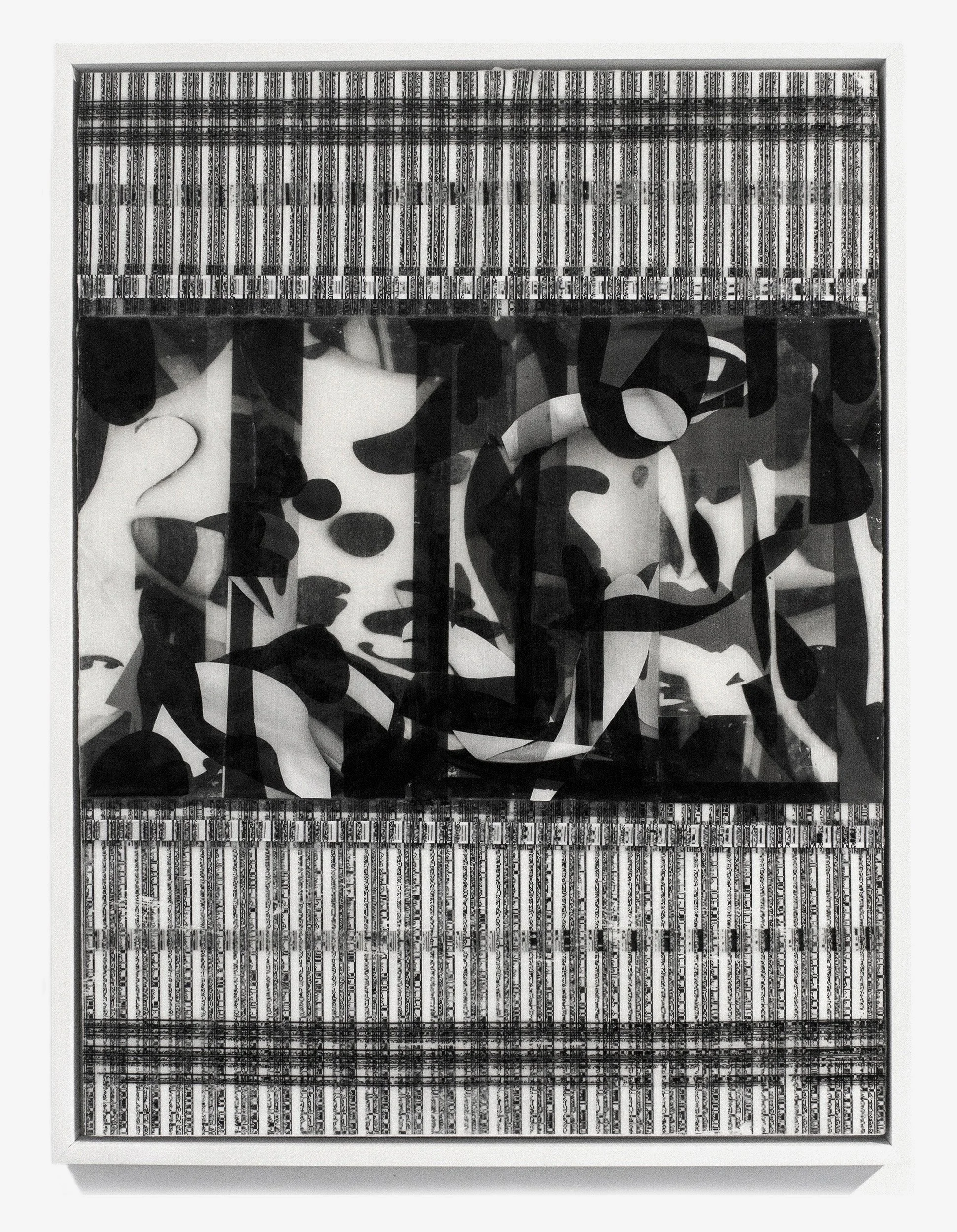
Screenplay 215, 2015. Digital transfer and paper on wood panel, 24 x 18”.
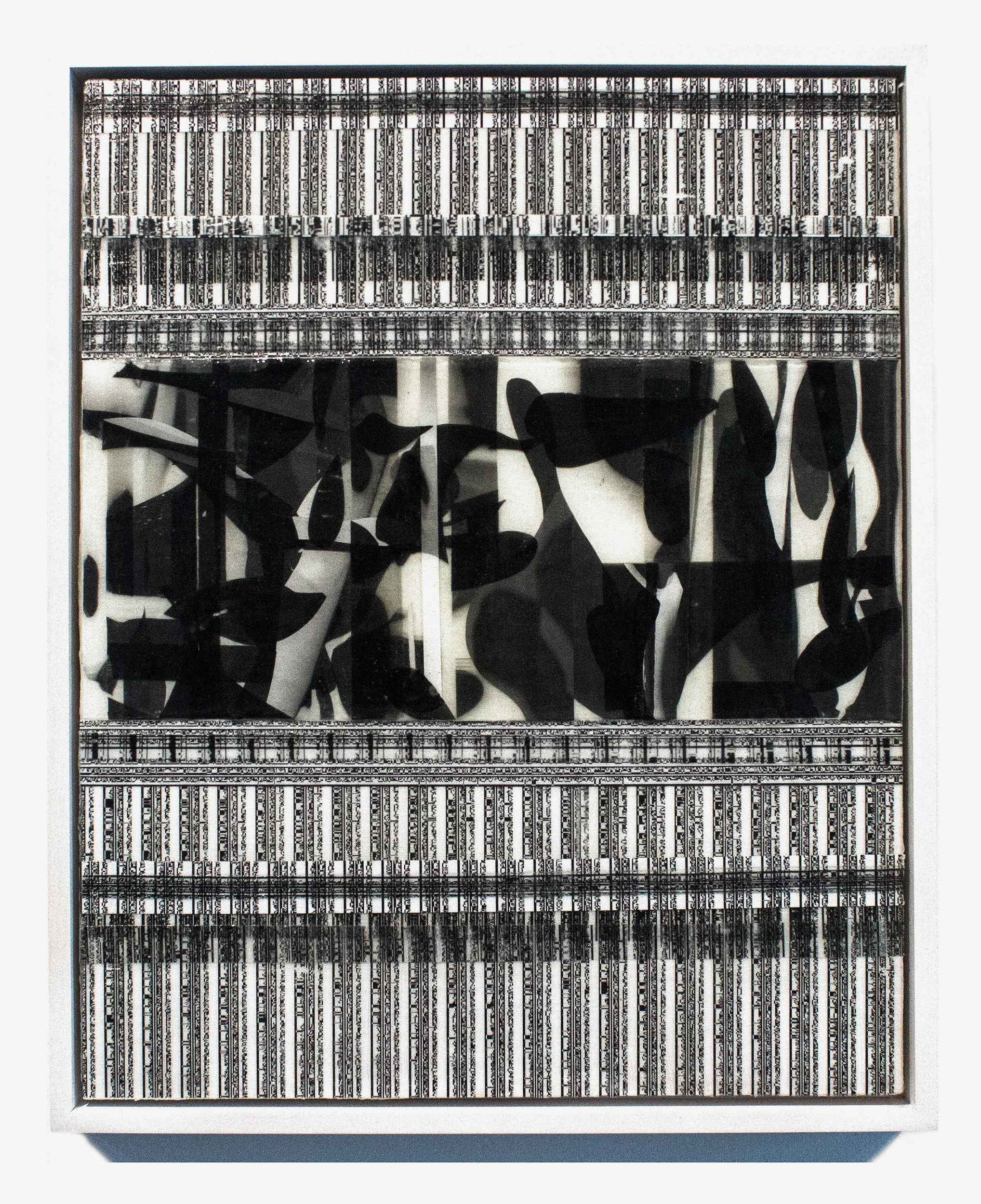
Screenplay 115, 2015. Digital transfer and paper on wood panel, 20 x 16”.
The Orb like the earlier series, Screenplay, uses digital transfers of imagery and patterns from Idiom, a print series created by capturing marking activity in mid-gesture. As with traditional drawing, the erasure-like process of digital transfer develops from light to dark.
Orb 415, 2015. Digital transfer and acrylic on wood panel, 22.5” diameter.
Orb 315, 2015. Digital transfer and acrylic on wood panel, 22.5” diameter.
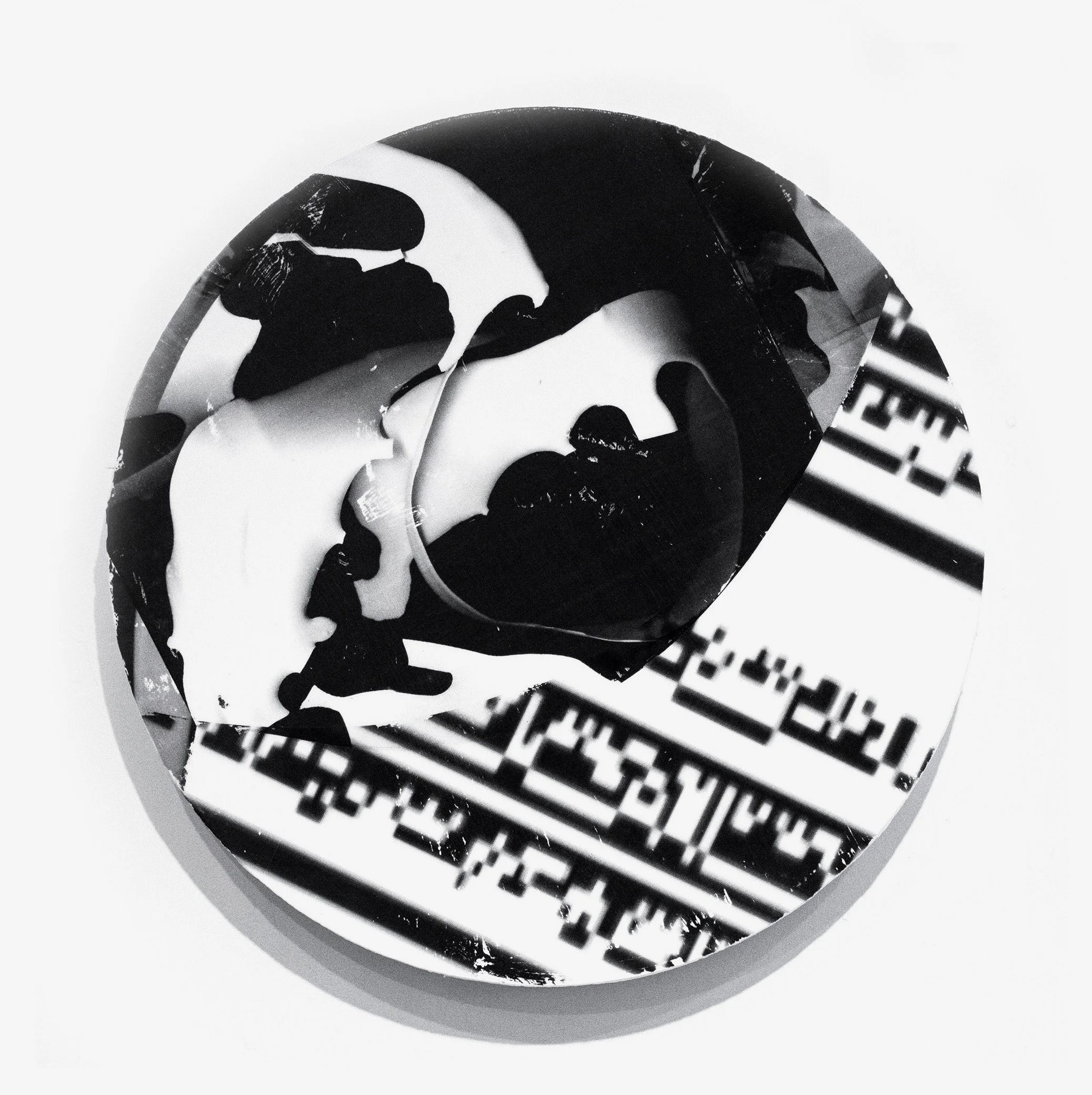
Orb 515, 2015. Digital transfer and acrylic on wood panel, 17.25” diameter.
Vernacular, a multi-panel deferred drawing series, continues the processes and image content used in Orb and Screenplay.
Vernacular 516, 2016. Layered acrylic and digital transfer on five panels, 24 x 130 x 1.75”.
Layered with translucent veneers of synthetic calligraphy interspersed with c.i.p.’s and previously painted marks, Chronicle continues in developing a visual language as well as documenting the processes and techniques I have used in my practice over the last fifteen years. Shifting the focus of preceding series such as Palimpsest and Script, which referenced manuscripts, Chronicle returns to a much earlier conversation on the relationship between a stitch and a mark. It is with this profound connection discovered fifty years ago in the sculpture of Lee Bontecou that began my transition from painting to sculpture by way of drawing.
Chronicle 2217, 2017. Layered acrylic with digital transfer on concave panel, 34 x 36 x 2.5”.
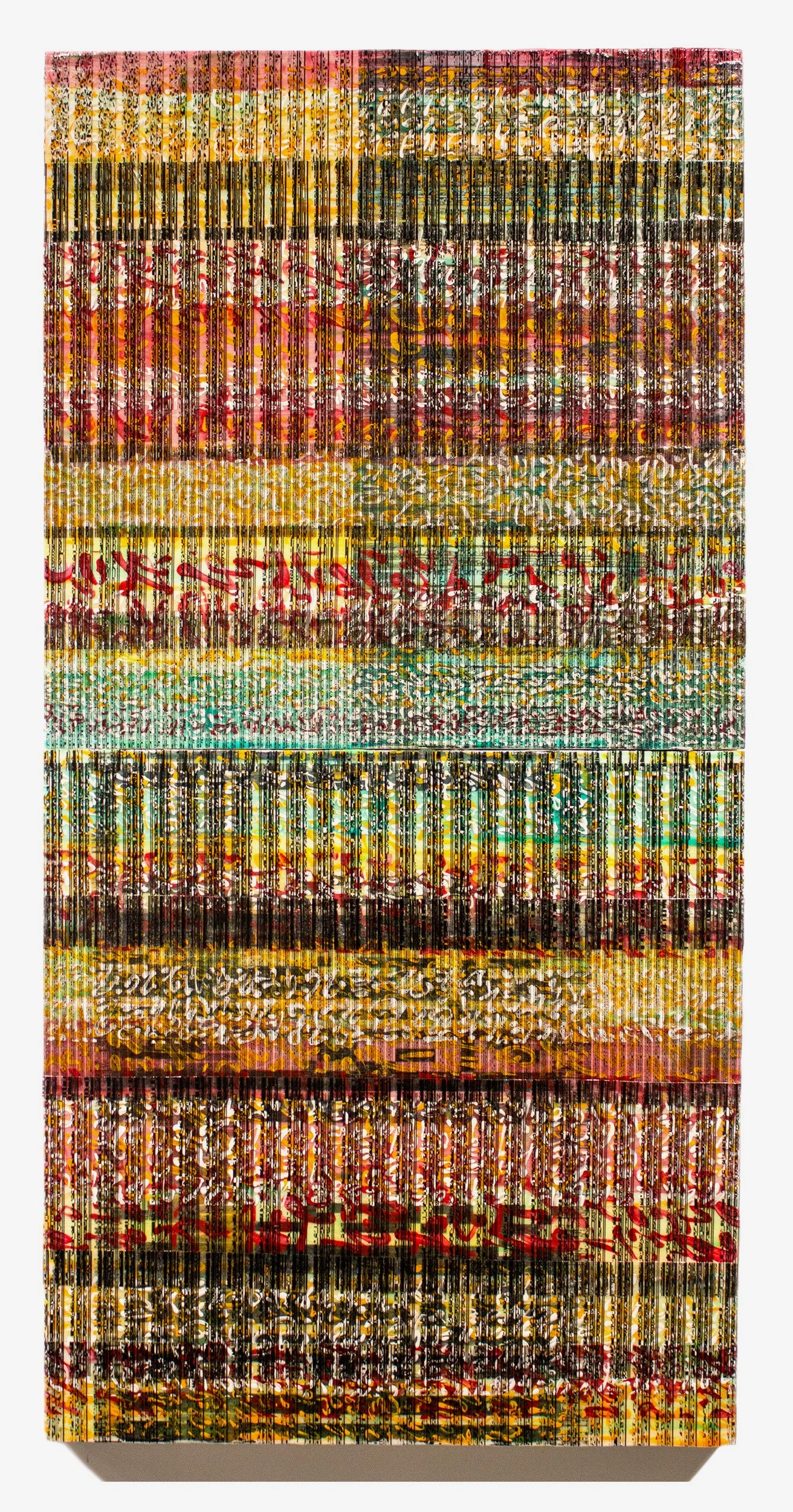
Chronicle 616, 2016. Layered acrylic with digital transfer on tapered panel, 48 x 24 x 1.75”.

Chronicle 916, 2016. Layered acrylic with digital transfer on tapered panel, 36 x 24 x 2”.
One of the complications from my open-heart surgery in September 2017 was ischemic optic neuropathy. The Blindsight Project, which began at the suggestion of Dr. Jeffrey G. Odel, explores some of my reactions to vision loss. Divided into five parts, The Blindsight Project, is an attempt at sharing my vision. Part 1 is Panorama, which tries to simulate my vision. Riffing on that simulation is Part 2, Metaphor. Parts 3 & 4, Lens and Filter focus on optical experiences like peripheral glimmer and floaters either monochromatically or with muted color. Unlike the four preceding Parts that are photo-based, Blindsight employs a combination of analog and digital techniques. Translucent veneers of past marking activity are layered on concave panels constructing a narrative that initiates a conversation on the relationship of sight and perception. Viewed together, The Blindsight Project hopefully conveys some of the emotions and mystery associated with my vision loss. Bllndsight Parts 1-4 continue in “part four-b: exploring the digital landscape” .
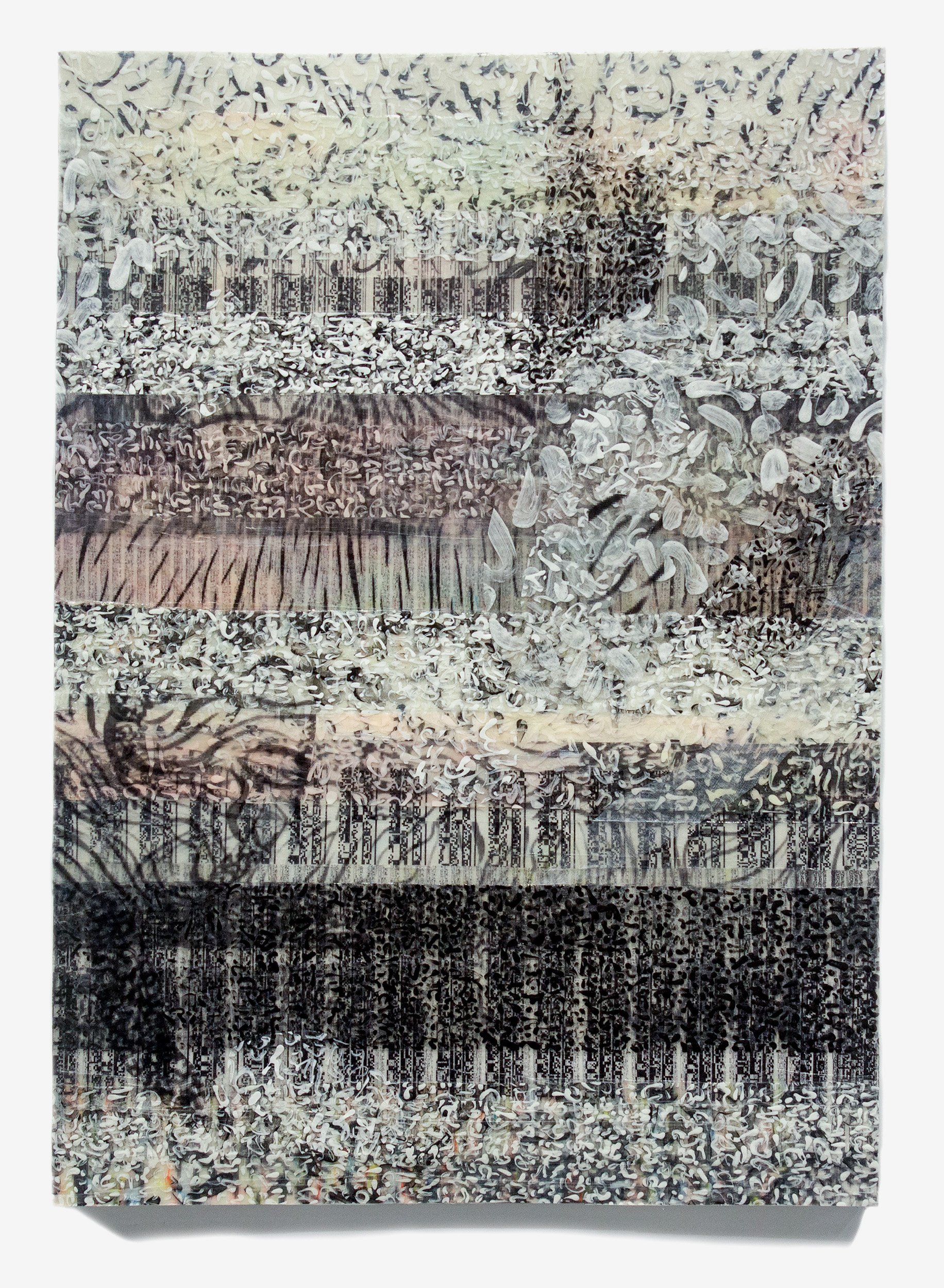
Blindsight 0318, 2018. Layered acrylic and digital transfer on concave panel, 28 x 20 x 1.75”.
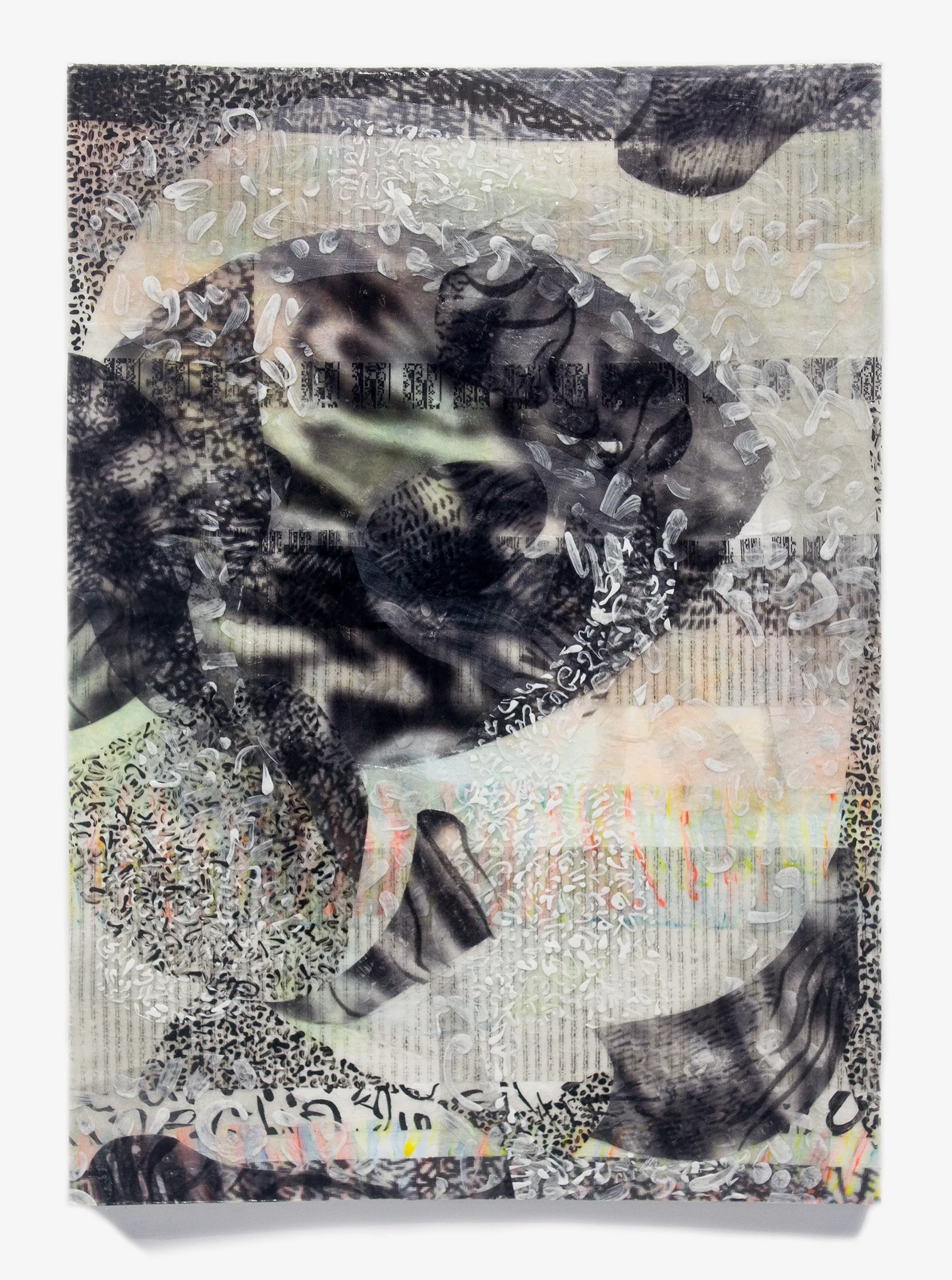
Blindsight 0418, 2018. Layered acrylic and digital transfer on concave panel, 28 x 20 x 1.75”.
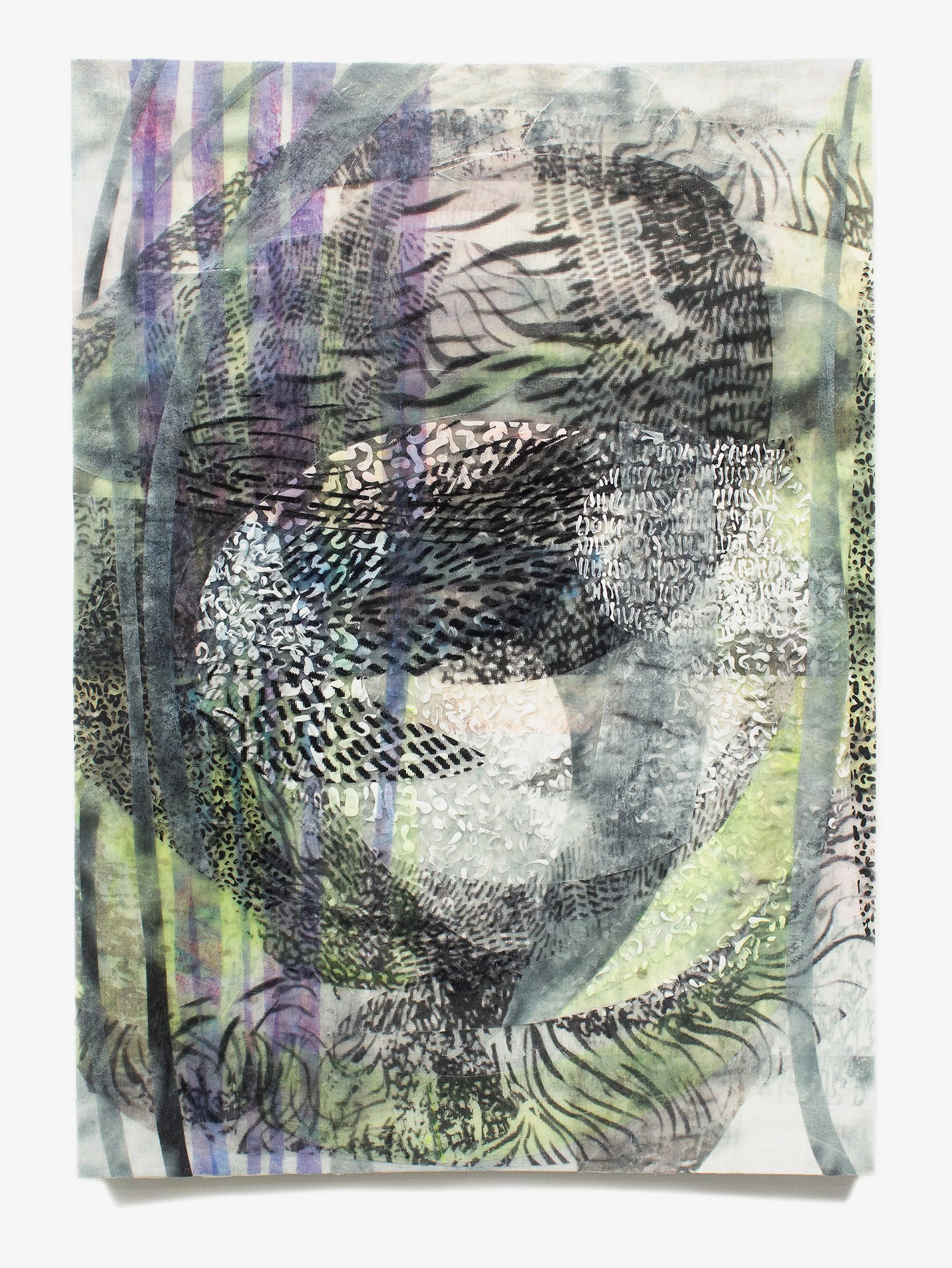
Blindsight 0518, 2018. Layered acrylic and digital transfer on concave panel, 28 x 20 x 1.75”.
Phases is a multi-panel, deferred drawing series following the technique of digital transfer used earlier in the Aperture series. In this case the patterns are derived from details of two pen and ink drawings, Rhapsody 1700 and Rhapsody 1800.
Phases: 3 Episodes v1, 2021. Acrylic and digital transfer on three panels, 24 x 72”, installed.
Babble is a pattern visualization of competing conversations. By deconstructing sentences into phrases that are transformed visually into linear structures, then arranged into fluctuating motifs layered over previous marking, Babble attempts to capture the energy of multiple conversations occurring simultaneously.
Babble 223, 2021–23. Applied acrylic and digital transfer on panel, 24 x 24 x 1.75”.
Babble 323, 2021–23. Applied acrylic and digital transfer on panel, 30 x 24 x 2”.
Translating the phrase structure in Babble into stylized patterns based on Neolithic community dwelling maps with added migration overlays was the primary focus of Twiddle. Color was used to heighten the spatial effect.
Clay tablet map fragments of Nippur circa 1600-1400 B.C.
Nippur Map fragment.
Clay Map Fragments of Nippur. Collection: University of Pennsylvania Museum of Archaeology and Anthropology.
Ground Plan of Skara Brae, 3180–2500 BC (after Childe, 1931). Drawing by Merryn Dineley.

Twiddle 524, 2024. Digital transfer and applied, layered acrylic on panel, 36 x 24

Twiddle 924, 2024. Digital transfer and applied, layered acrylic on panel, 36 x 24 x 2”.
My exploration of drawing over the last four decades began with the relationship of mark to pattern followed by a marking episode (drawing activity completed during a measured time segment) as a mark to pattern as a mark to collectively construct a new pattern. My accidental discovery of a marking system, which I titled c.i.p., has added another element to my vocabulary. Its impact and that of future discoveries will continue my inquiry into the relationships that exist between mark and pattern, gesture and language.