Drawing Primarily: Creighton Michael
a brief and annotated history of my relationship with drawing
Part Three
origins and developments in dimensional drawing
One of the factors in my return to sculpture was seeing a few pieces from the Constellation series by Alexander Calder. I was intrigued by the way these wood and wire constructions related to the wall while existing somewhere between drawing and sculpture.
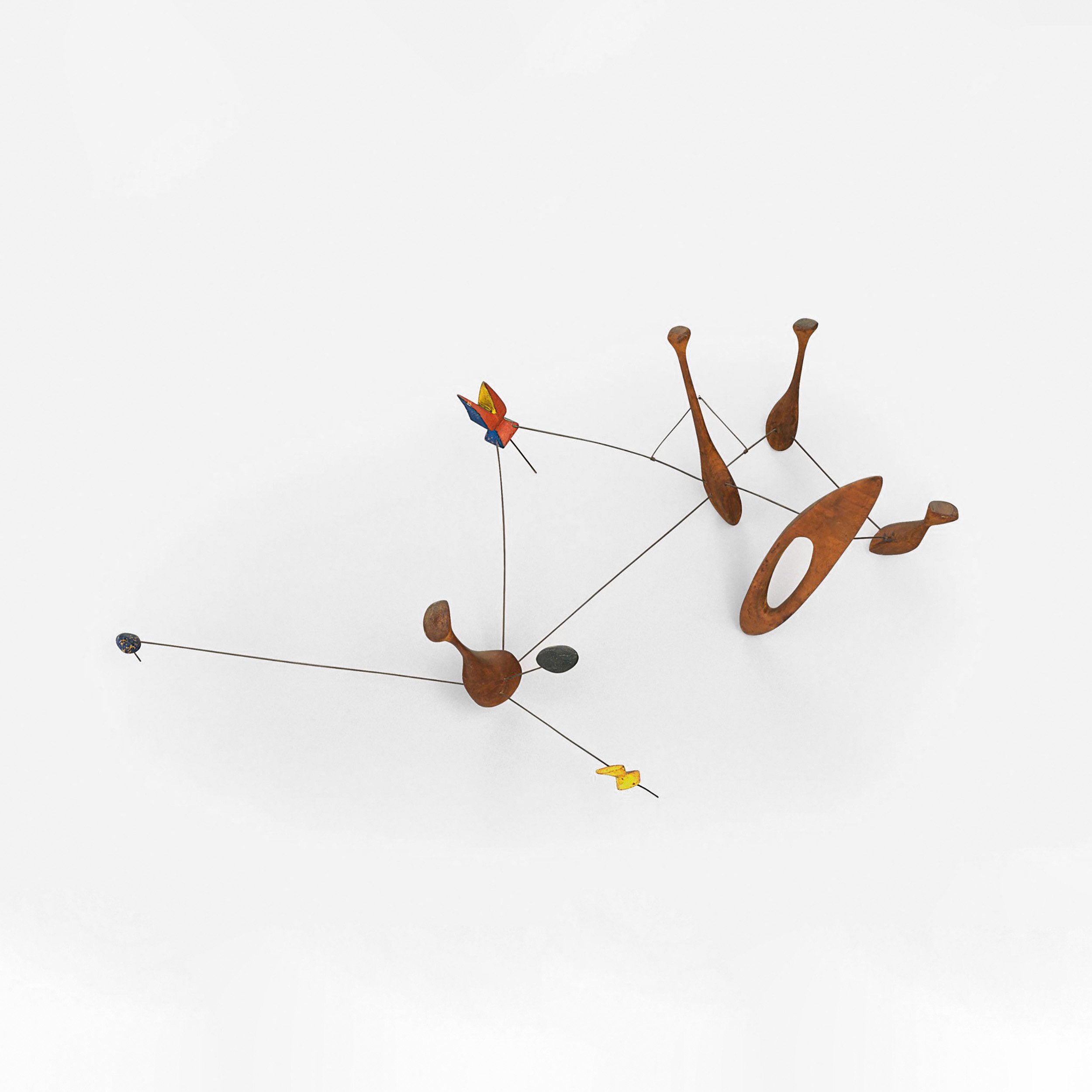
Constellation with Bishop, 1943. Wood and wire, 27 x 40”. Private collection, Calder Foundation.
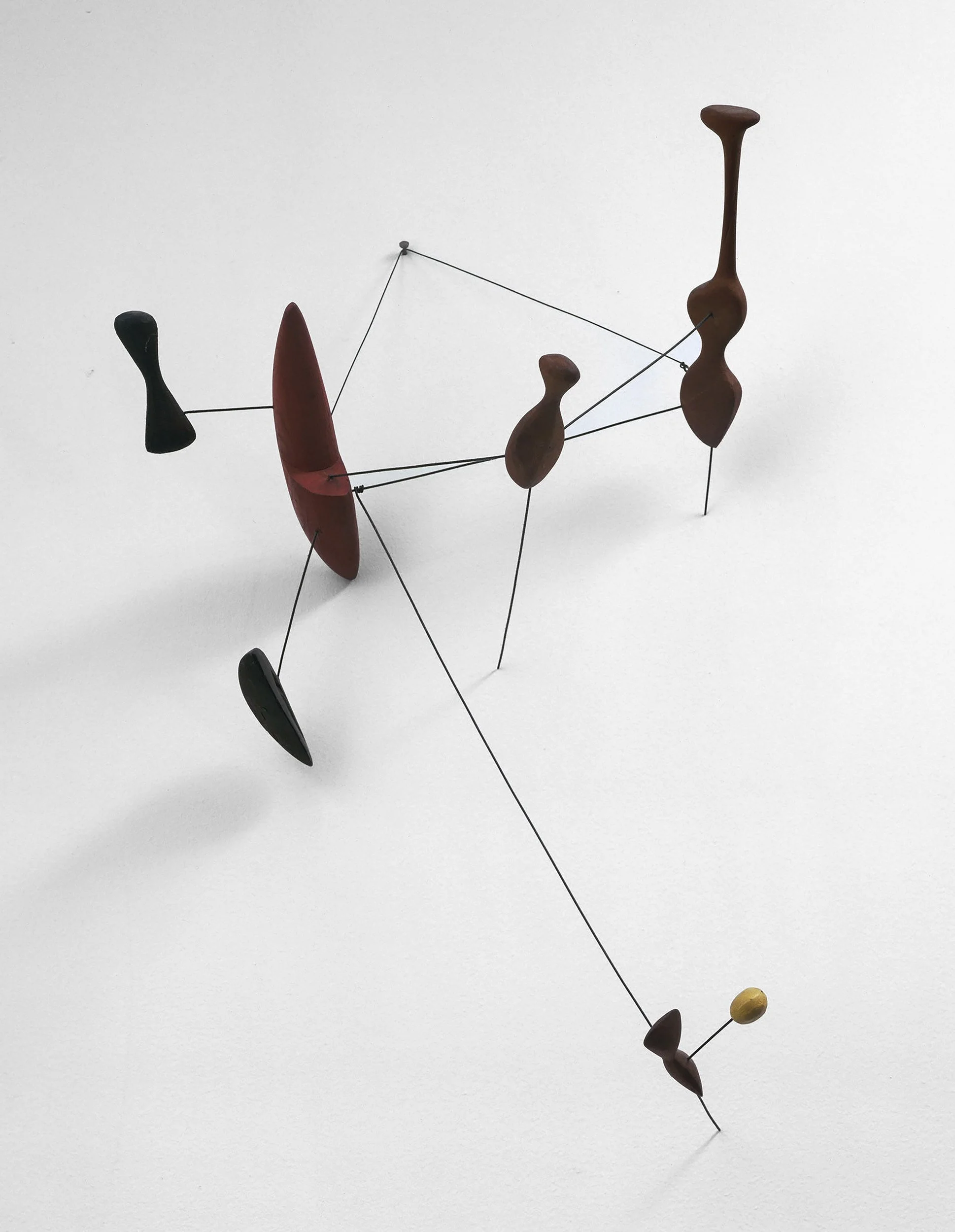
Constellation with Red Object, 1943. Wood and wire, 24.5 x 15.25 x 9.5”. The Museum of Modern Art (MoMA).
In addition to its influence on the direction of my painting in the late 1990’s, the Rhapsody series of pen and ink drawings would inspire a new body of three-dimensional work that would examine in physical terms the process and the structure of drawing. This new category is Dimensional Drawing.
Rhapsody 298, 1998. Ink on Bristol, 29 x 23”. The John and Maxine Belger Family Foundation, Kansas City, Missouri.
Rhapsody 1598, 1998. Ink on Bristol, 40 x 30”. Pfizer, New York.
The origin of Dimensional Drawing
During the Spring of 2002, three Purchase College students from my previous semester’s drawing class became my interns. As foreign exchange students, they had become friends while at WCC before transferring to Purchase. It was a challenge to have three individuals in the studio waiting for instructions, as I often worked alone and rarely had assistants. My process was basically intuitive, generally without any detailed strategy or planning. However, I recognized a possibility to alter my process and collaborate in different ways. This change in my practice would allow me to develop a new body of work that synthesized drawing and sculpture, Dimensional Drawings. Now, I would see drawing as a marking system like other marking systems such as calligraphy, choreography, and musical composition. With this return to sculpture, I planned to use humble, everyday materials, supplies that could be found at any hardware store. This choice of nontraditional art materials echoed an earlier decision in 1976 when I moved from painting to sculpture by way of drawing.
Grid 202, 2002. Steel wire and acrylic, 15 x 30 x 4.5”.
Each Grid has an accompanying schematic with information on drill locations, unit and grid creation as well as the artist’s signature, authenticating the work. Just as a musical score informs the musician, the schematic instructs the preparator as to unit placement. This connection between drawing and music would lead to collaborations with composers.
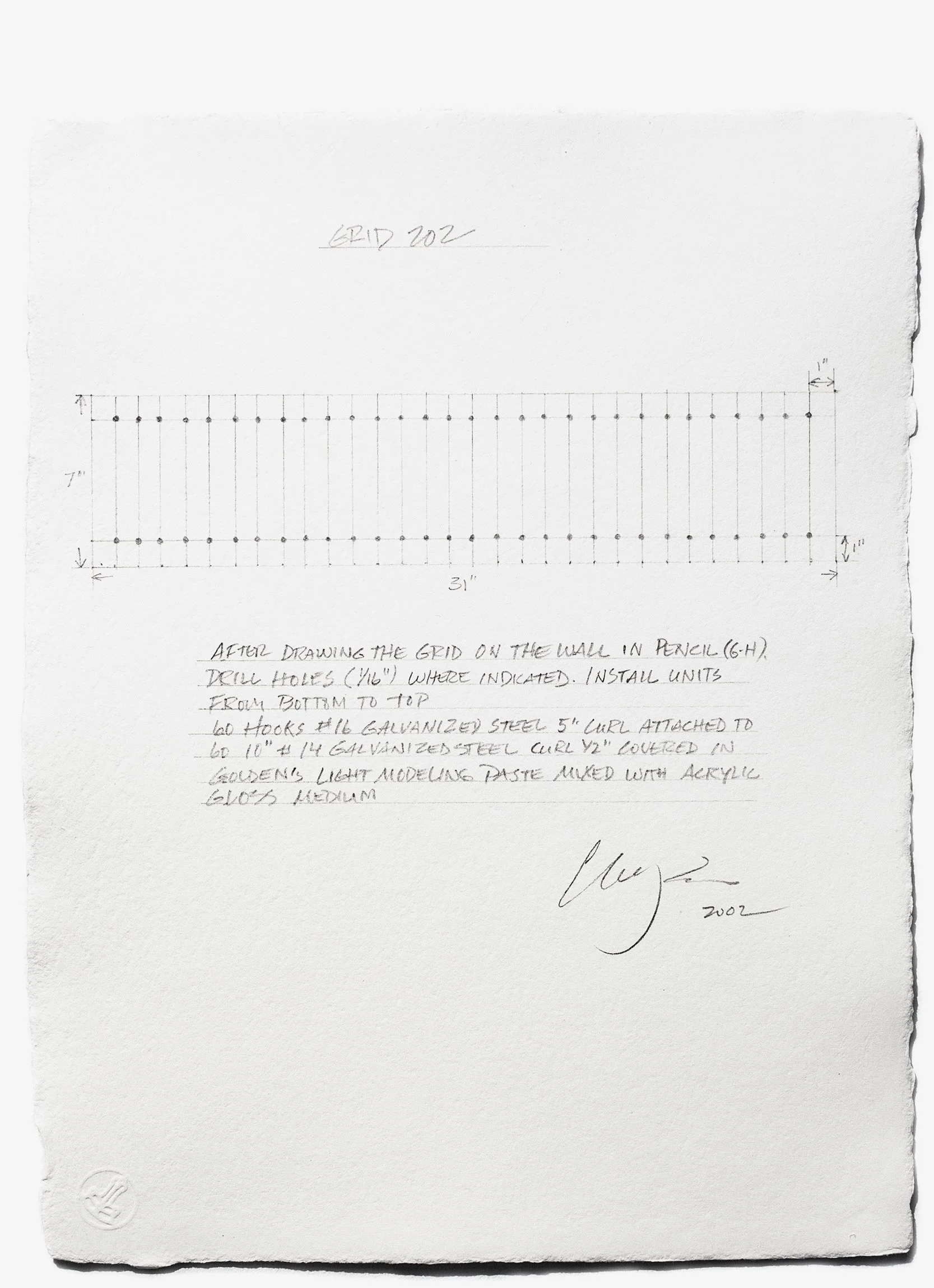
Grid 202 (schematic), 2002. Graphite on paper, 12 x 9”.
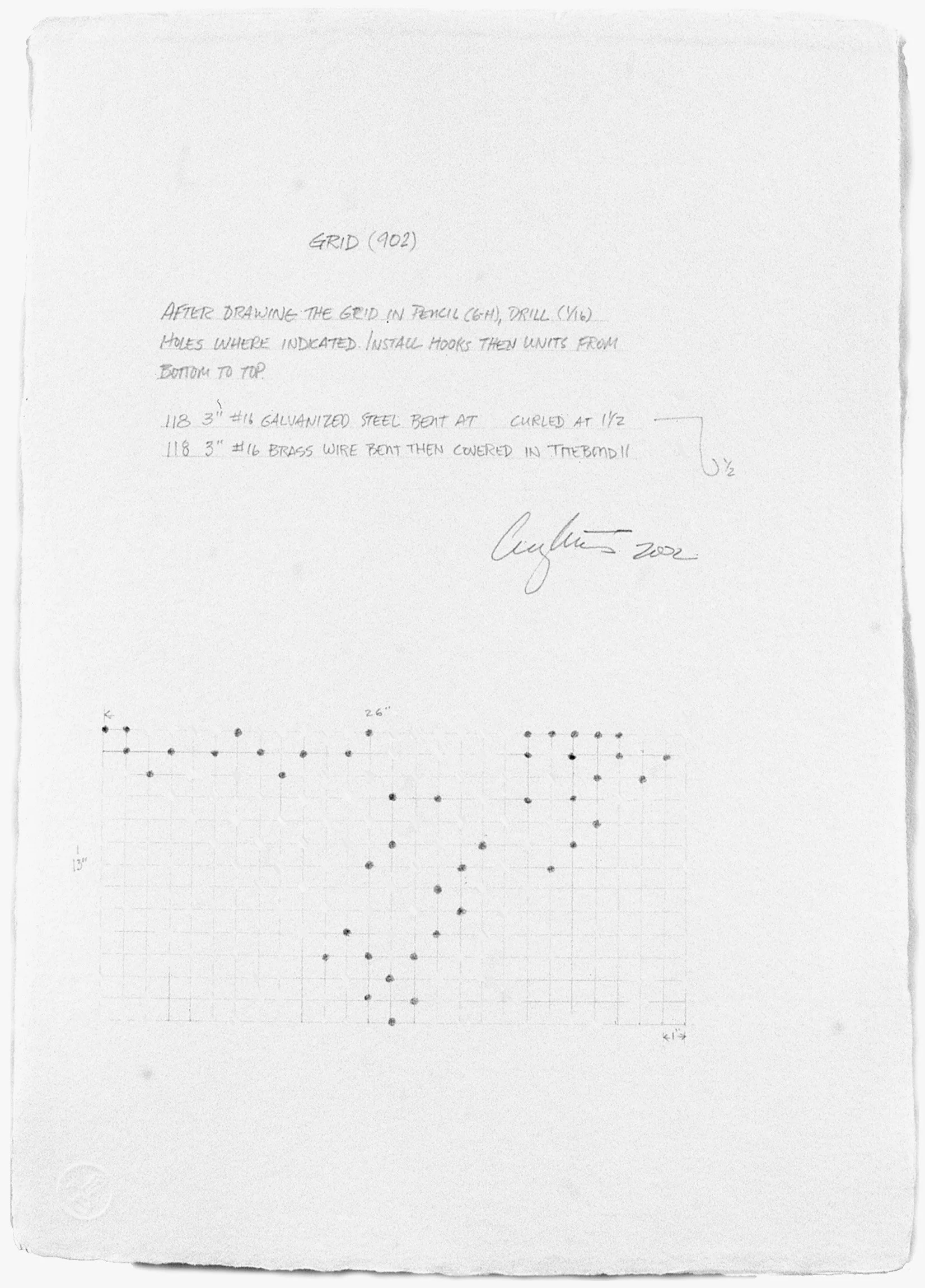
Grid 902 (schematic), 2002. Graphite on handmade paper, 14 x 10”. Private collection, New York.
The early works experimented with a variety of grid sizes before arriving at the 30”, 24” or 12” square as the standard format. Endeavoring to emulate the numerous hand motions linked to drawing or marking, the units and their resulting patterns appear as cellular fabrications, suggesting such natural components as leaves or feathers. Often in these early pieces, the emerging pattern treats the space within the grid as a sheet of paper attached to the wall. Later drawings physically fill the square format suggesting the wall functions as a sheet of paper and the grid as a detail of a larger drawing.
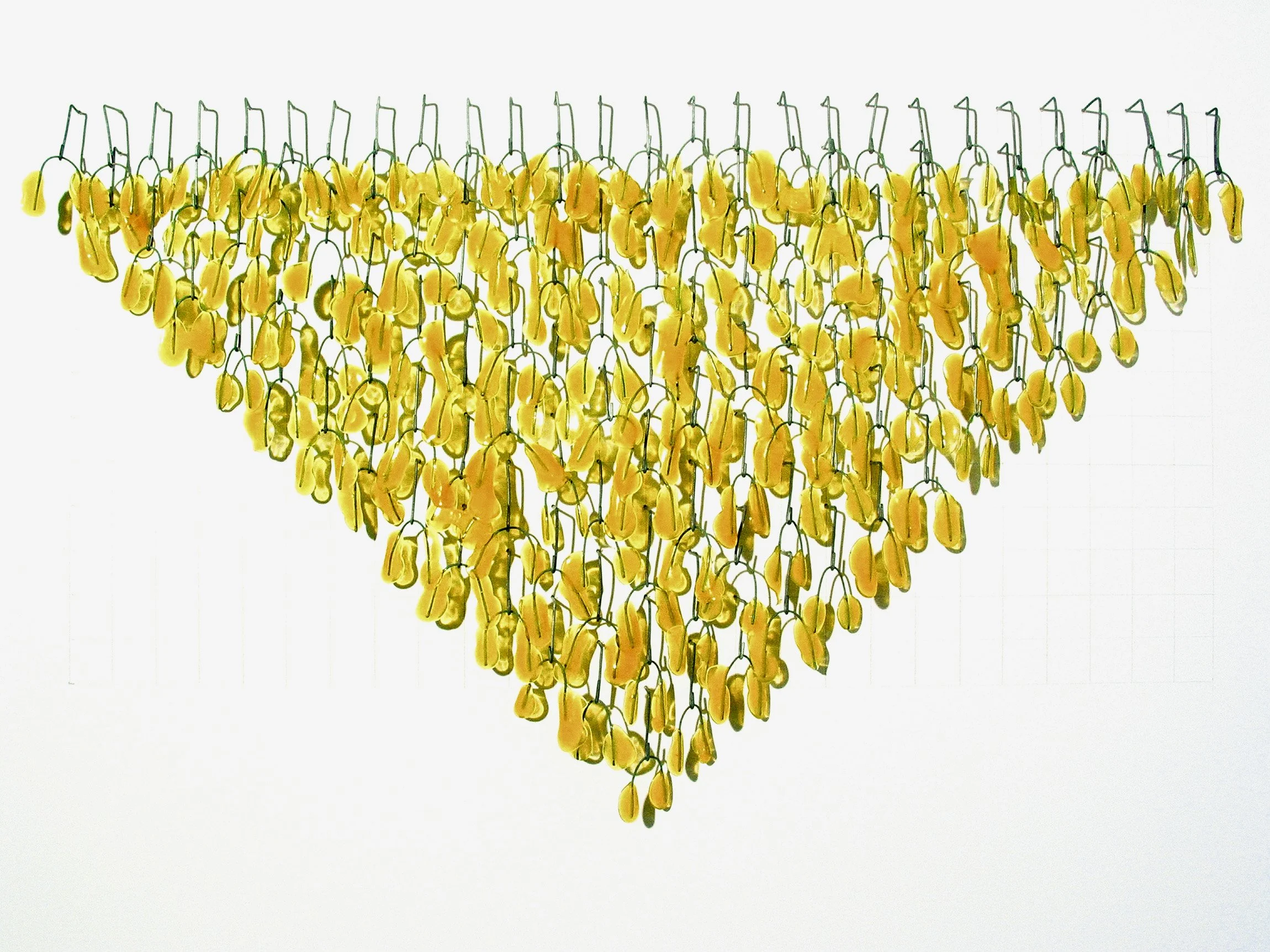
Grid 902, 2002. Steel, brass, wire, and glue, 16 x 28 x 1.5”. Private collection, New York.
Grid 1102, 2002. Copper wire, glue, and acrylic, 27 x 12 x .5”.
Grid 1102 (schematic), 2002. Graphite on handmade paper, 14 x 10”.
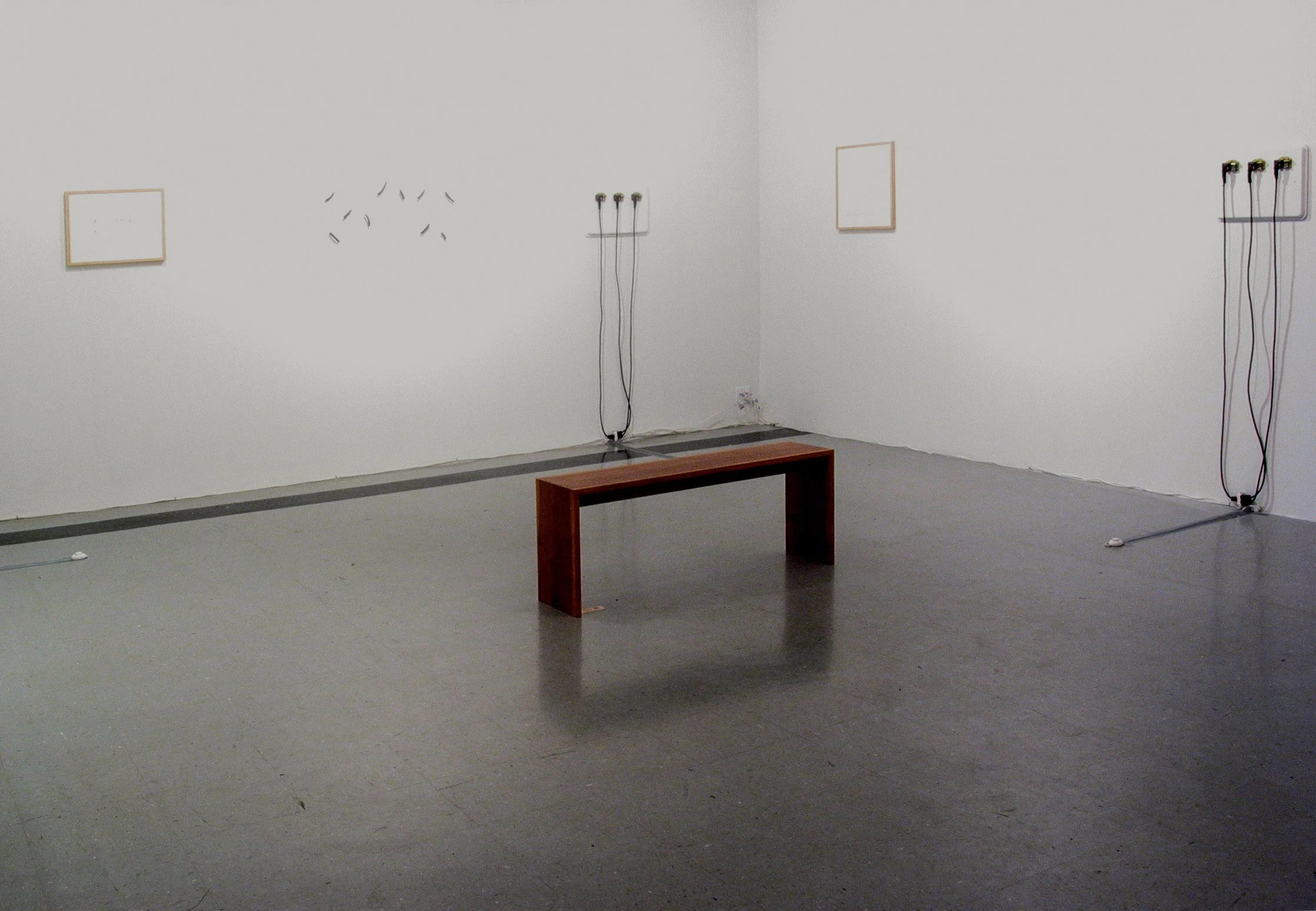
Talking to Peter, 2003. Collaboration with composer John Morton. Installation view, Beacon, New York.
Talking to Peter a drawing and sound collaboration with composer John Morton, 2003
My first collaboration between dimensional drawing and music was with composer, John Morton in 2003. John manipulated the cylinders from music boxes to mirror the patterns in specific Grid pieces. In turn I created works based on the prints from inked cylinders that John had previously exploited.
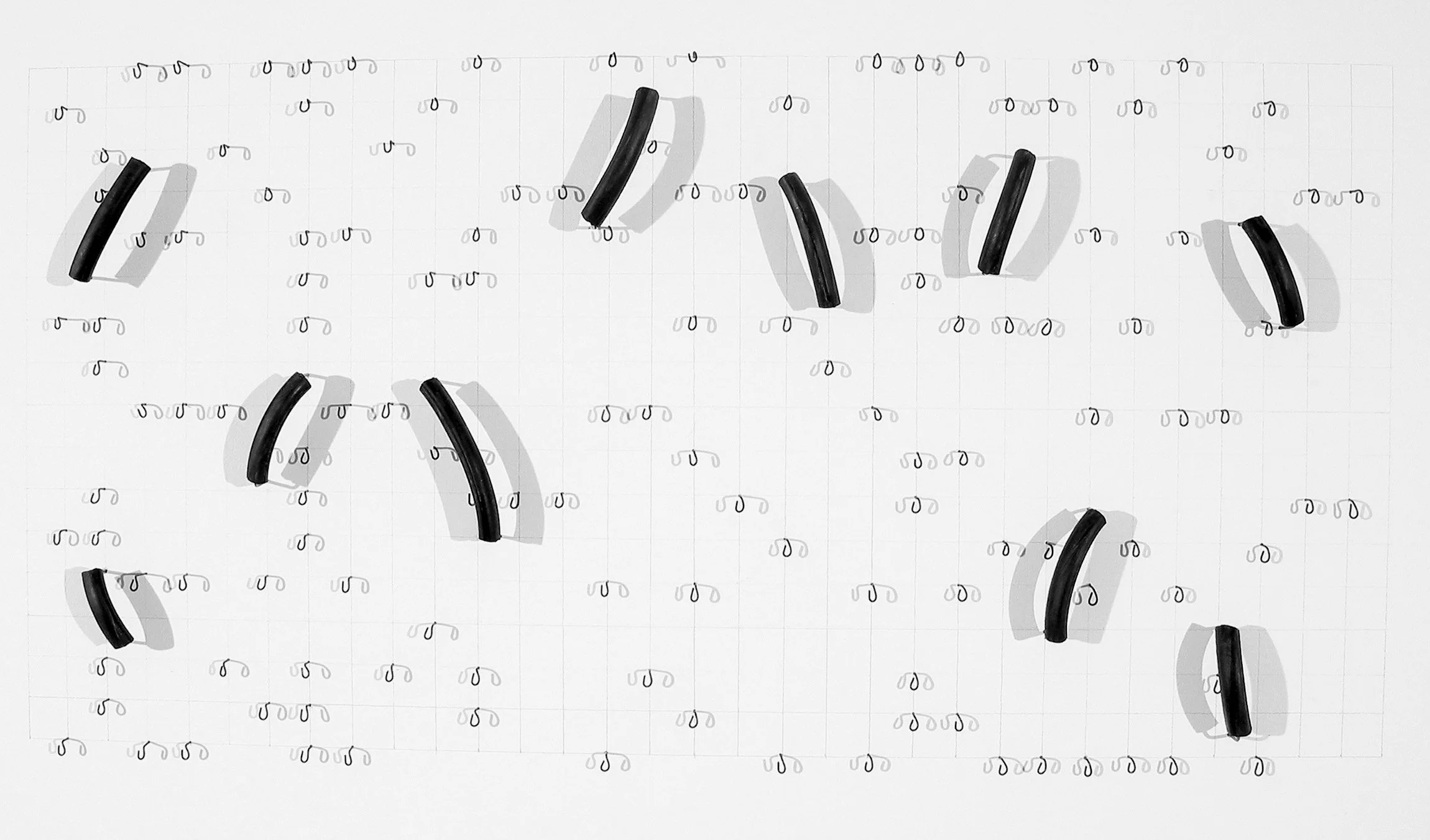
Talking to Peter, 2003. Collaboration with composer John Morton. Installed grid.
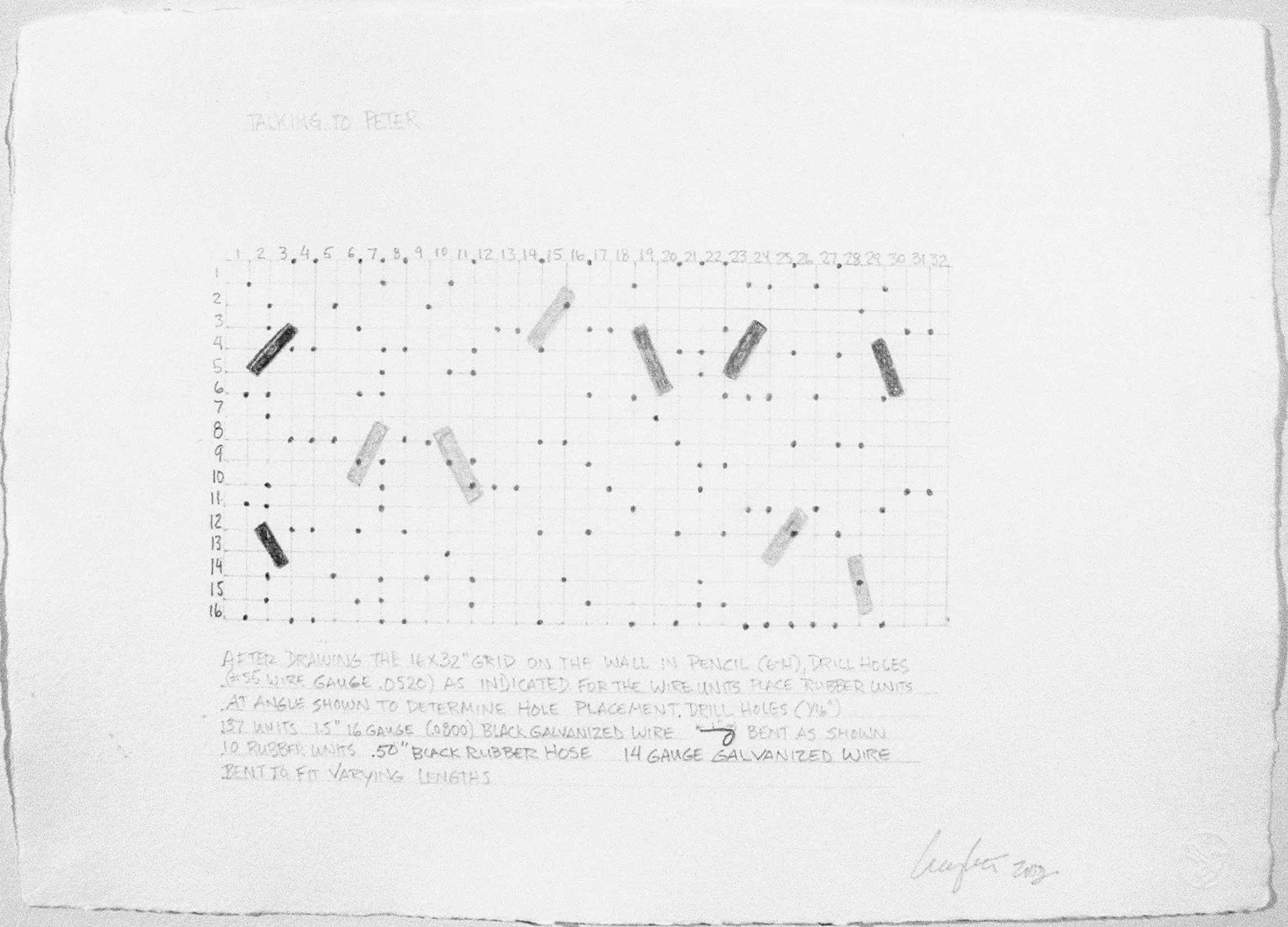
alking to Peter, 2003. Collaboration with composer John Morton. Accompanying schematic.
Grid translates the repetitive hand function associated with drawing into tangible units or marks used in making a drawing. “The marks”, composed of wire and individually shaped, are combined with glue, plastic or rubber tubing, then inserted into predrilled holes in the wall. Shadows not only enhance the dimensionality of each unit but also replicate the motions occurring in drawing activity. Grid mergers the process of drawing with the physical presence of sculpture.
Grid 2203, 2003. Steel wire, 24 x 24 x 1”.
Grid 2203 (schematic), 2003. Graphite on handmade paper, 14 x 14”.
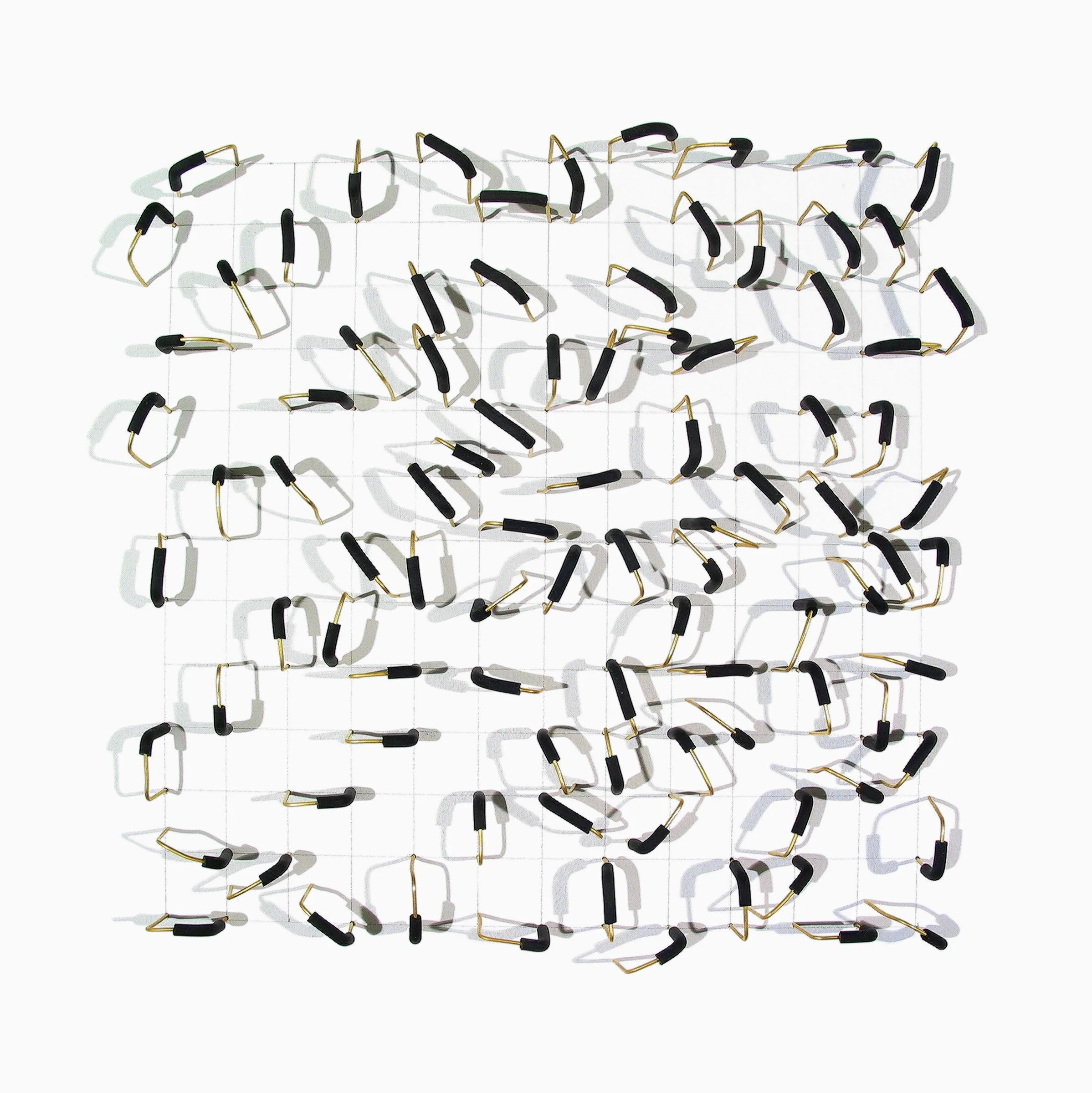
Grid 2703, 2003. Rubber tubing over brass wire inserts, 12 x 12 x 1”; dimensions vary. Private collection, Florida.
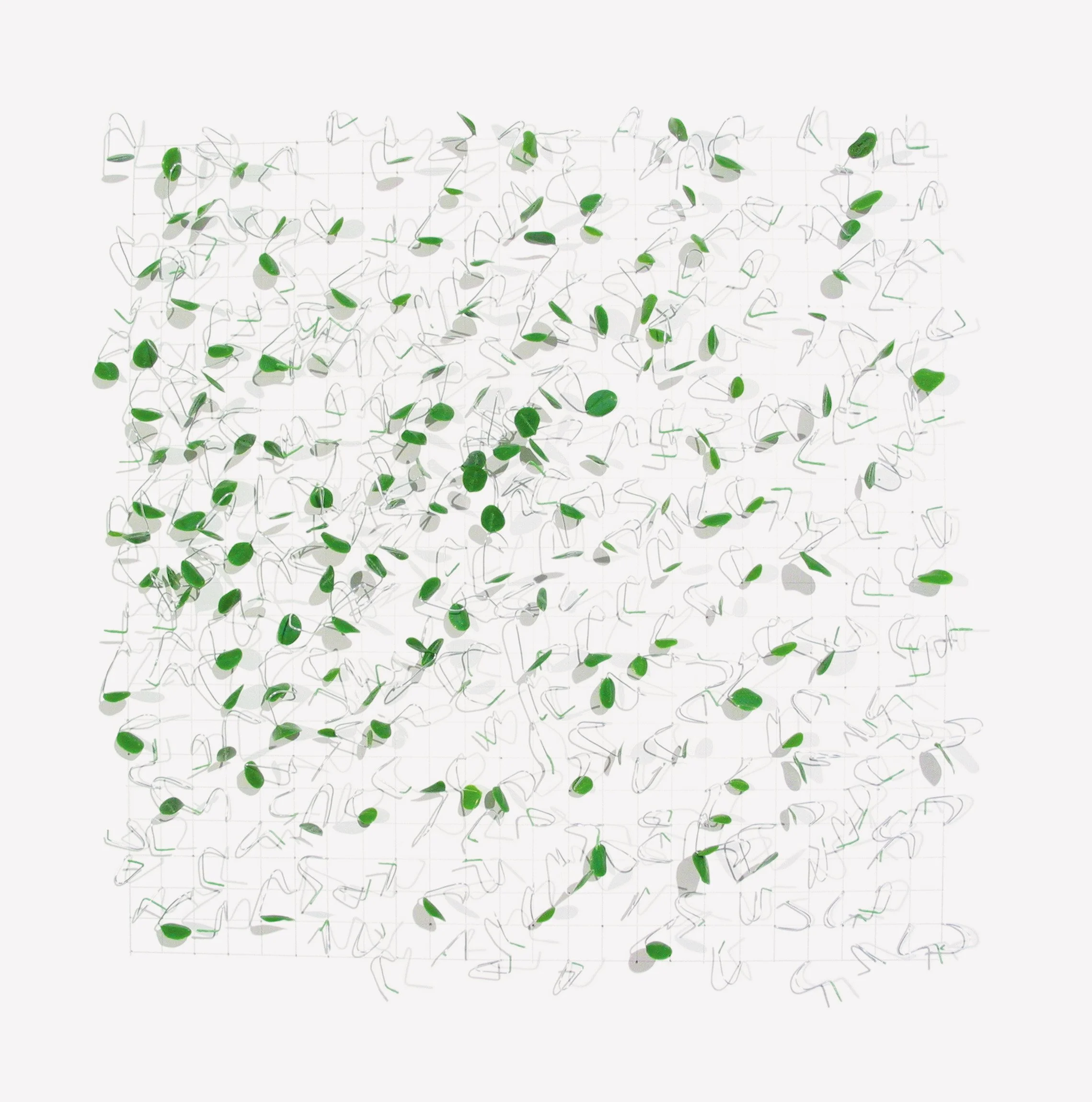
Grid 2504, 2004. Steel wire, glue, and acrylic, 24 x 24 x 1.5”; dimensions vary.
By 2006 wire marks had been replaced with wire marking episodes as drawing units.
A similar change will occur with the creation of the Rhapsody sculpture series in 2008.
Grid 3005, 2005. Brass and copper wire, acrylic, glue, and plastic tubing, 24 x 24 x 1.5”.
Grid 4007, 2007. Steel wire, 30 x 30 x 6”.
Beginning in 2004, the Grid series would leave the wall for the quadrilateral pedestal. These 60” high plinths reference both drawing and sculpture, while encouraging the viewer to experience the drawing in transitional, three-dimensional space.
Grid 3804, 2004. Steel wire and rubber tubing, 24 x 12 x 3.5”. Plinth: 60 x 12 x 12”. Private collection, New York, New York.
Grid 4605, 2005. Steel and copper wire, rubber tubing, glue, and acrylic, 24 x 12 x 5.5”. Plinth: 60 x 12 x 12”.
Grid 5011. Rubber tubing over steel wire; dimensions vary.
d.i.p. is another series of dimensional drawings with the acronym, “drawn in paper” that developed the same time as did the Grid’s. Unlike the Grid series that focused on the gesture as a mark, d.i.p. interests were the composition of a mark. A wooden dowel, a reference to the structural material of my earlier sculpture, is teed then dipped into a mixture of paper pulp, graphite and acrylic to create an individual mark or module. These drawing units are placed through a paper template into the wall, constructing a drawing one mark at a time. For reinstallation, each mark is numbered with a corresponding number located at each hole on the template.
d.i.p. 402, 2002. Graphite and paper-coated dowels, 36 x 36 x 3.5”.
d.i.p. 402 (template), 2002. Pencil on Bristol, 40 x 60”.
d.i.p. 703, 2003. Graphite and paper-coated dowels, 37 x 54 x 3.5”.
d.i.p. 703 (template), 2003. Pencil on Bristol, 40 x 60”.
A marking episode is the duration of a marking activity, the realization of which occurred during the creation of the Rhapsody series of pen and ink drawings. These drawings were a culmination of marking sessions covering several weeks. A marking episode can also be a doodle or cluster of doodles connected in time.
Rhapsody 1800, 1998. Ink on Bristol, 40 x 30”.
Rhapsody 1700, 2000. Ink on Bristol, 40 x 30”. University of Richmond Museums, Richmond, Virginia.
Segment is composed of one hundred, 18-inch sections of twine, each tied to the other forming an ellipse. In every piece either the square knot or the length of twine is painted to contrast with its remaining section, clarifying the difference between knots and twine. As a continuous line, Segment becomes a contour drawing composed of marks (knots) and lines (distance between the knots). Like the Grid, the accompanying schematic instructs the preparator as to the wall plan allowing for random variations. Unlike Grid, which focuses on the hand and wrist movements occurring during the drawing process, Segment directs attention to the broader gestures developed by arm and shoulder motion.
Segment 103, 2003. Twine and acrylic; dimensions vary.
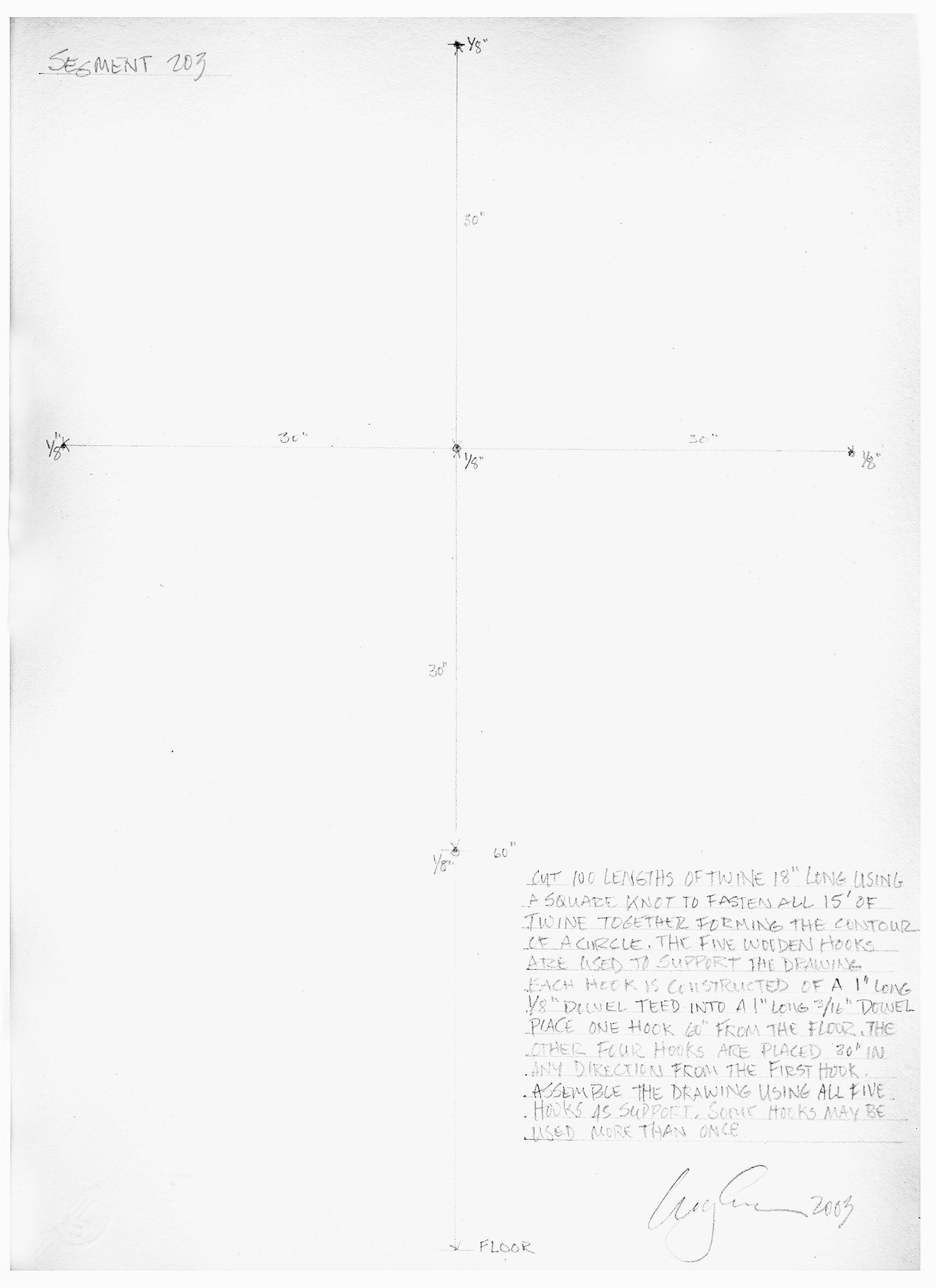
Segment 103 (schematic), 2003. 14 x 10”.
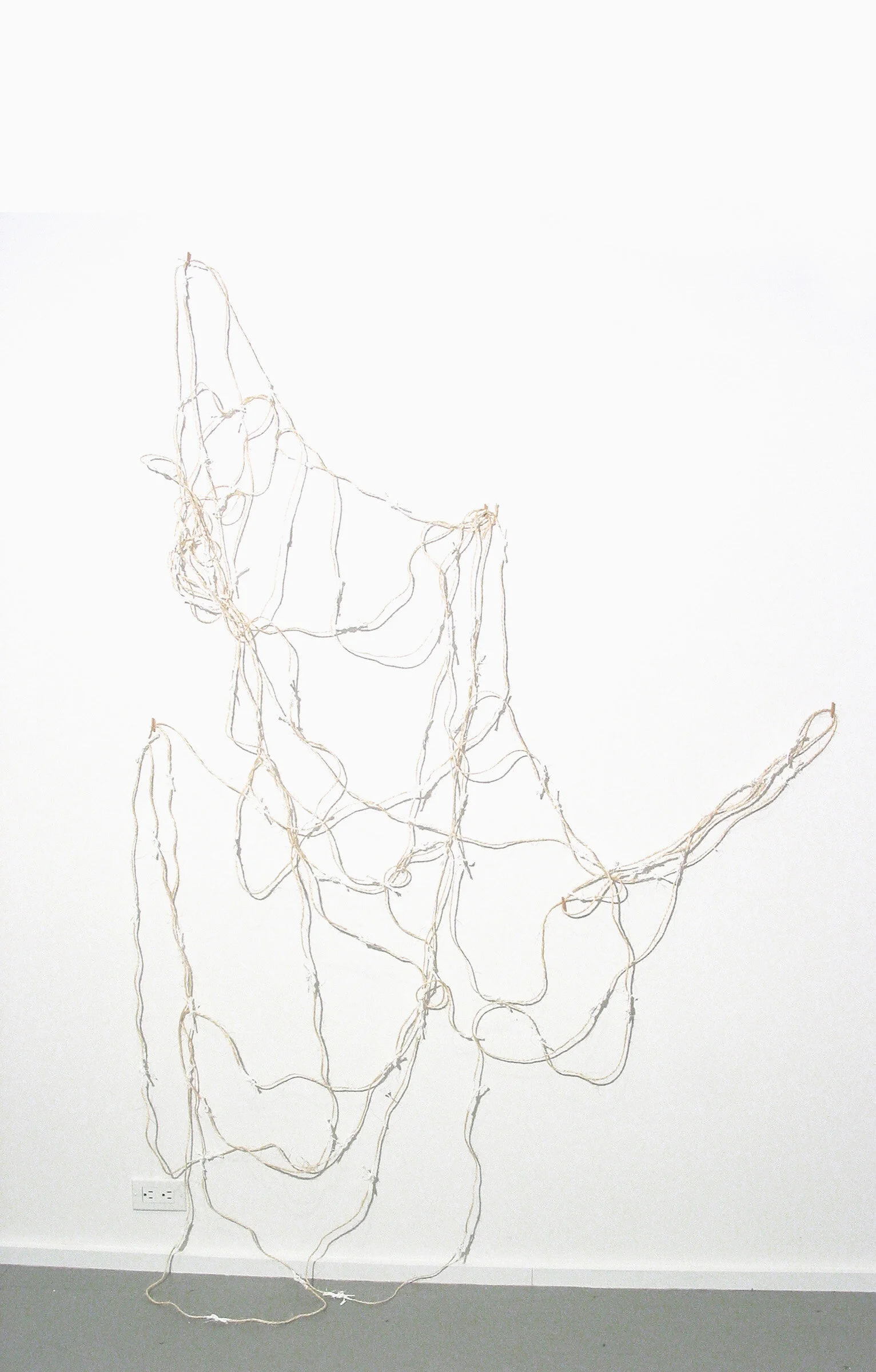
Segment 404, 2004. Twine and acrylic; dimensions vary.
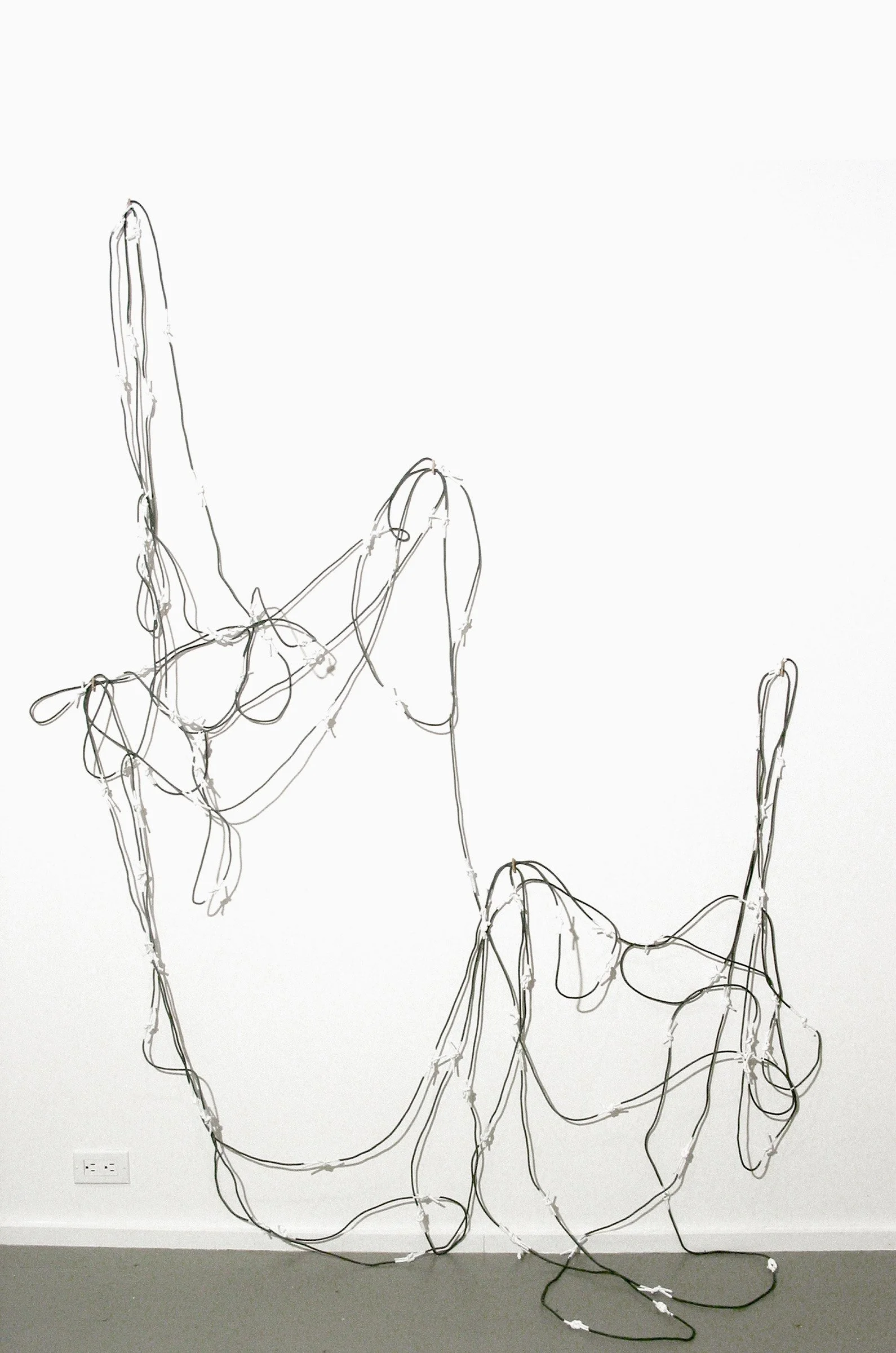
Segment 504, 2004. Twine and acrylic; dimensions vary.
Squiggle and Scribble are series of installed works mimicking the physical action of marking or writing by focusing on the shape and composition of the selected marks. Like the gestures employed in the construction of van Gogh’s pen and ink landscapes, these calligraphic segments explore the vibrant nature of chirographic patterns residing at the intersection between drawing and writing. Made of various lengths and widths of cotton rope and coated with a paper pulp and graphite mixture or in the case of Scribble a charcoal paper pulp concoction, the marks in both Squiggle and Scribble achieve the variety and intimacy of traditional drawing. Unlike traditional drawing, which characteristically records a moment, action or image in time, Squiggle and Scribble assume the transitory nature of installation.
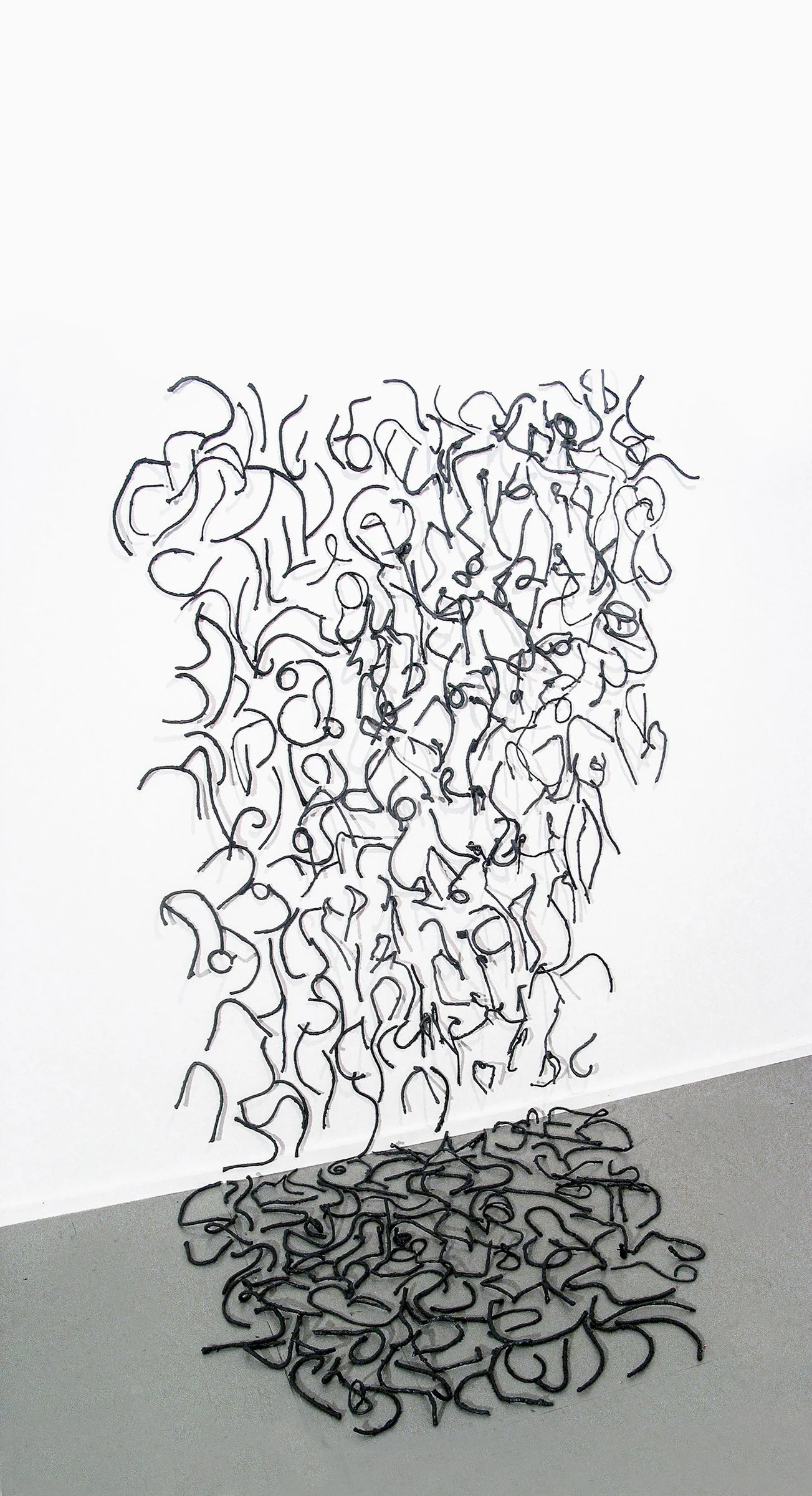
Squiggle 104, 2004. Graphite and paper-coated pipe cleaners; dimensions vary.

Squiggle 404, 2004. Graphite and paper-coated pipe cleaners, 84 x 60 x 8”; dimensions vary.
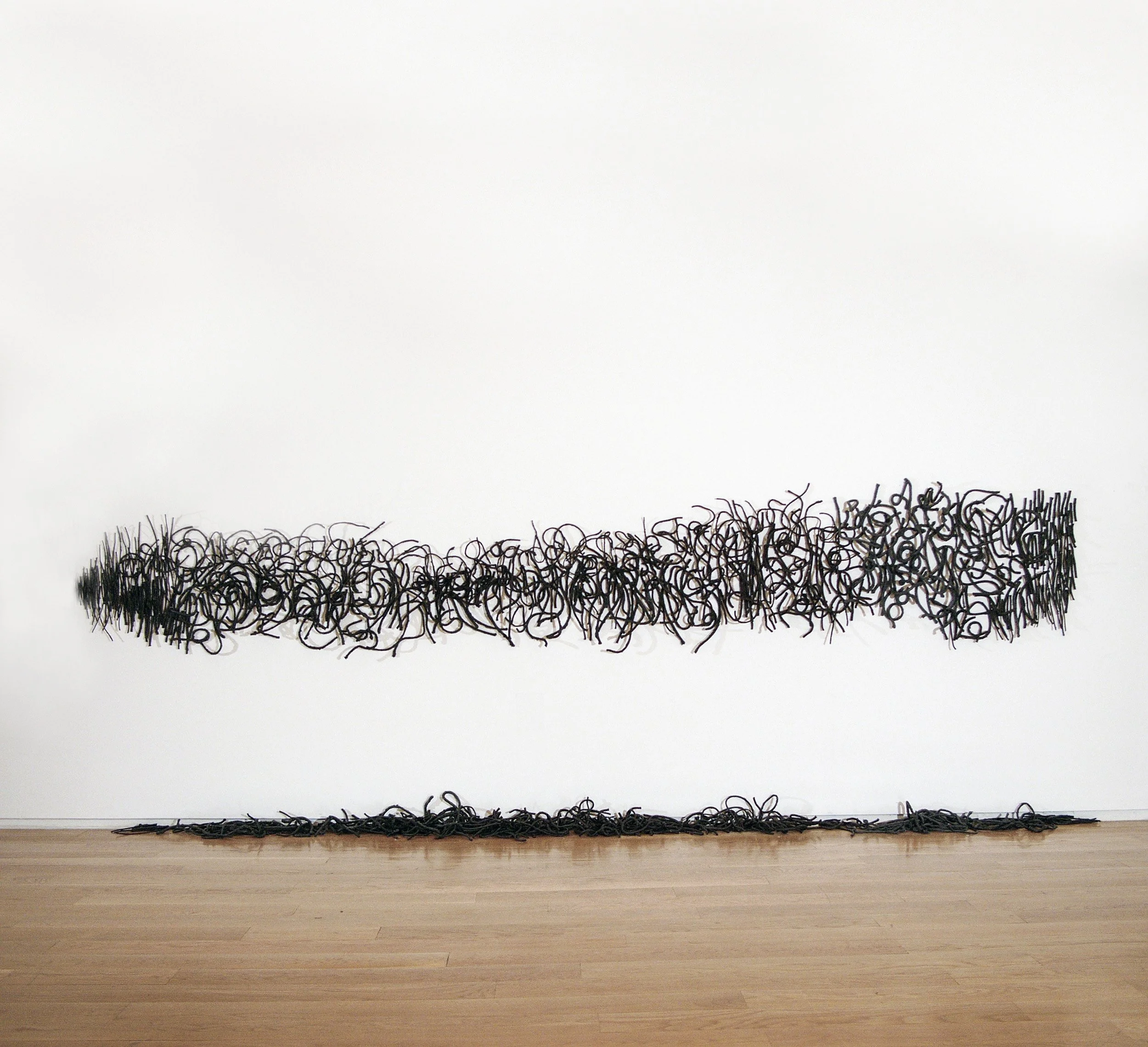
Squiggle Tenri, 2005. Graphite and paper-coated rope, 48 x 144 x 5”. Installation: Tenri Cultural Institute, New York City.
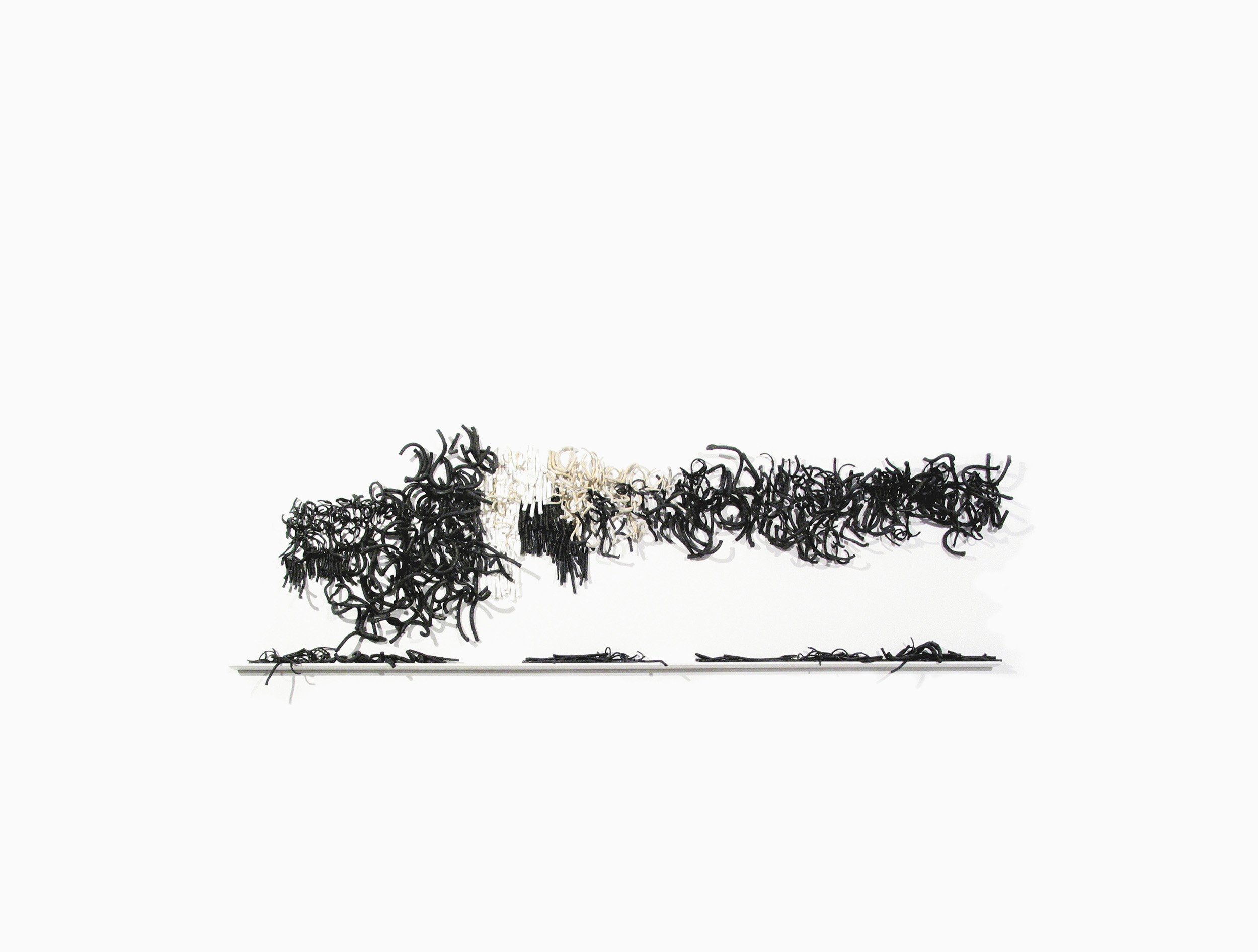
Scribble 307, 2007. Charcoal- and acrylic-coated rope with wire inserts, 65 x 186 x 6”. Installed at Blue Star Art Center, San Antonio, in the exhibition Monumental Drawings, curated by Barbara MacAdam.
Composed of wooden dowels coated with a mixture of paper and charcoal, Tuck combines certain features of two earlier series, Grid and d.i.p. The “marks” or drawing units are constructed with 1/8” and 3/16th” dowels. The resulting units are either 3” or 4” modules. Because the placement holes, located at every intersection within the grid are 1/8” holes, only the 1/8” dowels of each module can be inserted. Placement and selection of each unit are at the discretion of the installer. The increasingly random choices made by the preparator result in transforming the drawing’s appearance after every installation. With Tuck’s shifting shadow pattern and spatial ambiguity, it becomes more difficult for the viewer to distinguish between form and space, substance and illusion.
Tuck 103, 2003. Charcoal and paper-coated dowels, 72 x 48 x 3.5”.
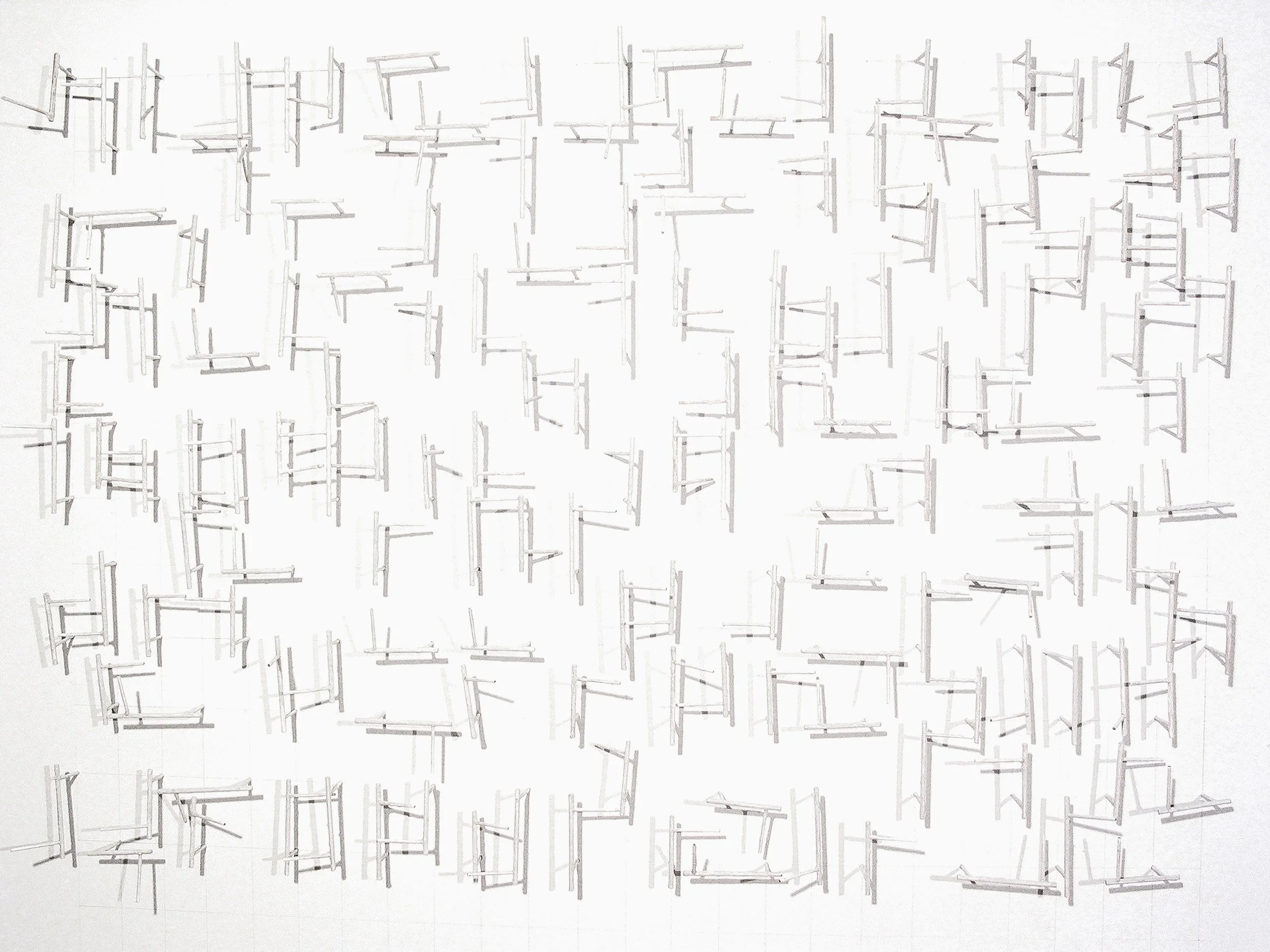
Tuck (detail)
Glyph synthesizes elements from other series to expand the possibilities of drawing dimensionally. Composed of rope segments in various sizes and shapes, these wire attached filaments are coated with a mixture of graphite, acrylic, and paper, then inserted into the wall within a 24” square grid.
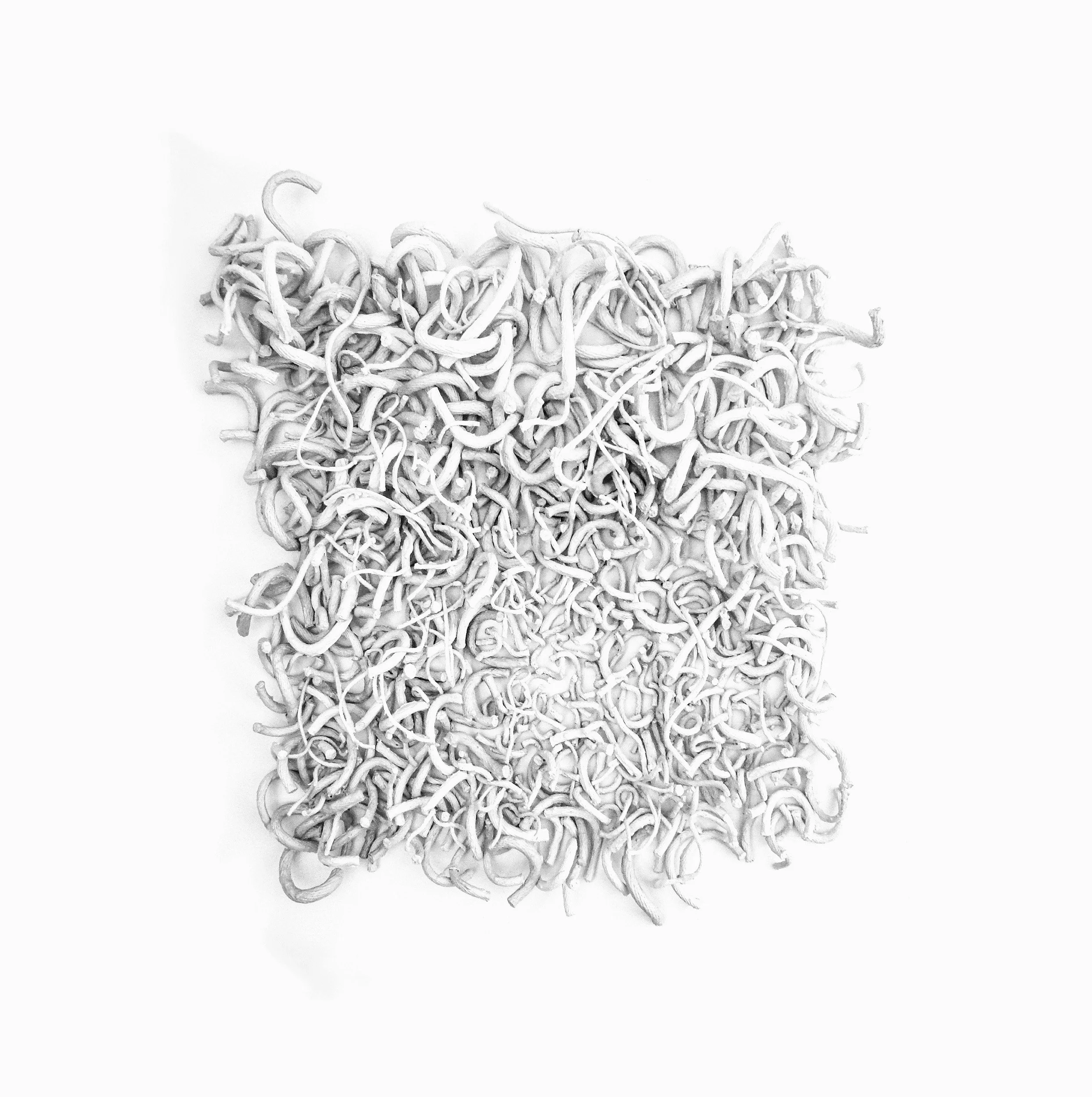
Glyph 108, 2008. Graphite and paper-coated rope, 30 x 29 x 7”; dimensions vary. Private collection, New York City.
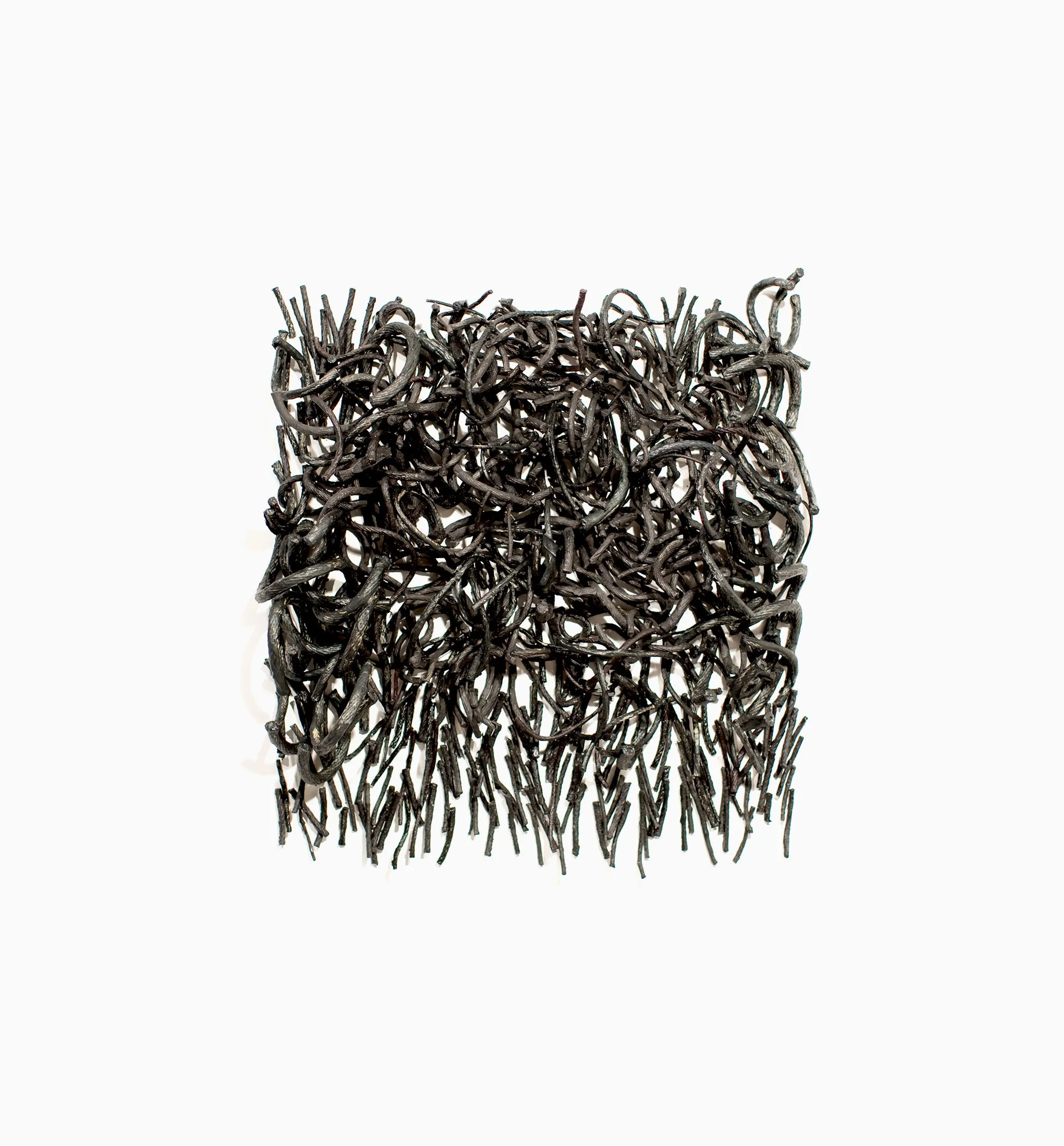
Glyph 208, 2008. Graphite and paper-coated rope, 28 x 25 x 6”; dimensions vary.
The marking episode as a contained doodle or sequence of doodles first appears in Pull, a series of drawings consisting of graphite, shellac and gesso. Acting as both an eraser as well as a fresh, and somewhat translucent ground, gesso provides the viewer with the drawing’s layered history. To give the gesture a sense of volume and create the drawing’s push/pull dynamic, incremental marking is adding to one of the veiled sections leaving the other section visually flat, resulting in a visual counterpoint.
Pull 697, 1997. Graphite, shellac, and gesso on Bristol, 17 x 14”.
Pull 1097, 1997. Graphite, shellac, and gesso on Bristol, 24 x 19”.
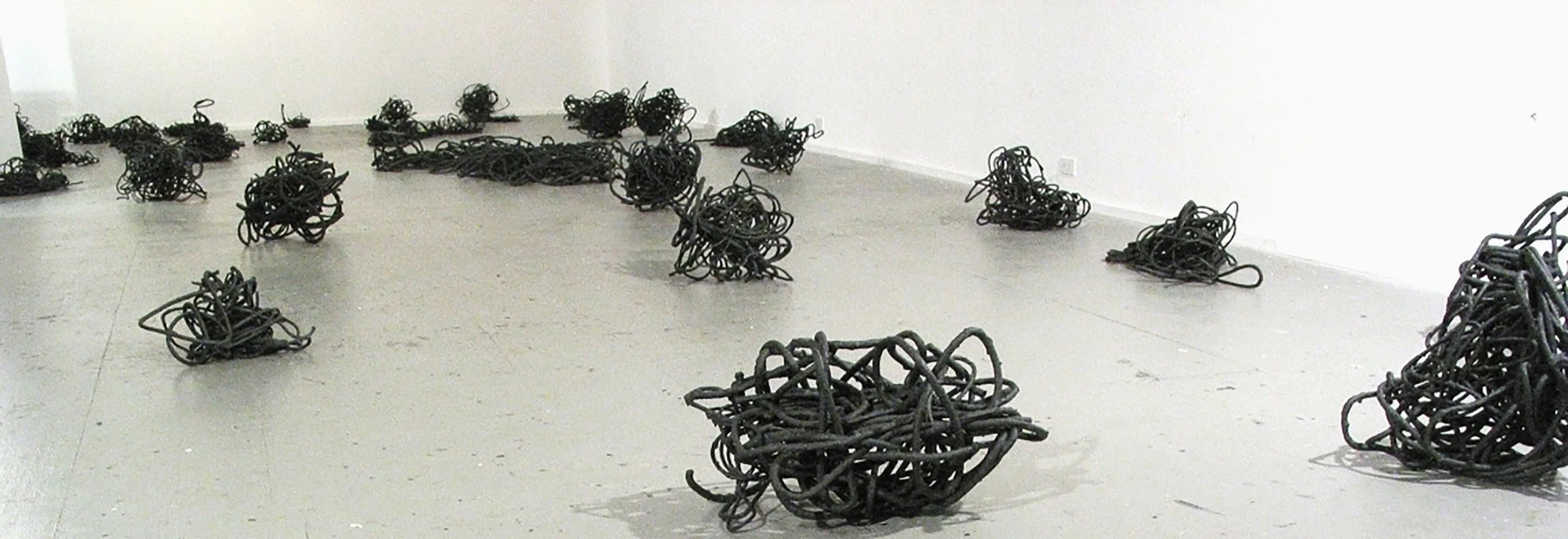
Two views of my studio mockup.
Alta Price, like Paninat Roper, was another drawing student that became my studio assistant. She too worked with me exploring new ways to expand my practice. With Alta, the idea that drawing was a marking system related to other marking systems like calligraphy, choreography and musical notation helped to develop new possibilities for my practice.
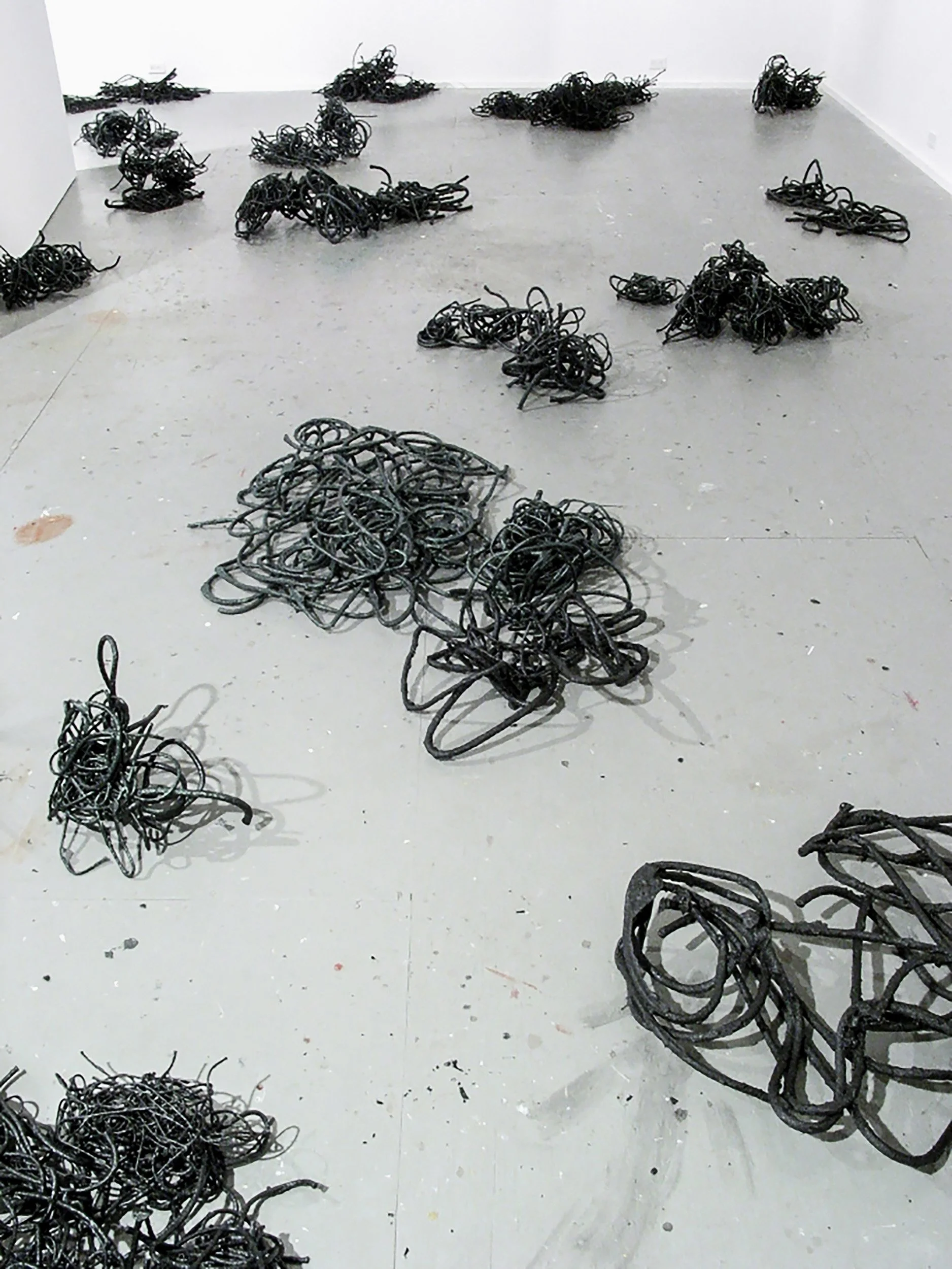
Inspired by the moss that carpets Iceland’s landscape and the cairns (varða) that punctuate its pathways, RhapsodyfloorHorizon was an attempt at capturing the mysterious beauty of Iceland through drawing.
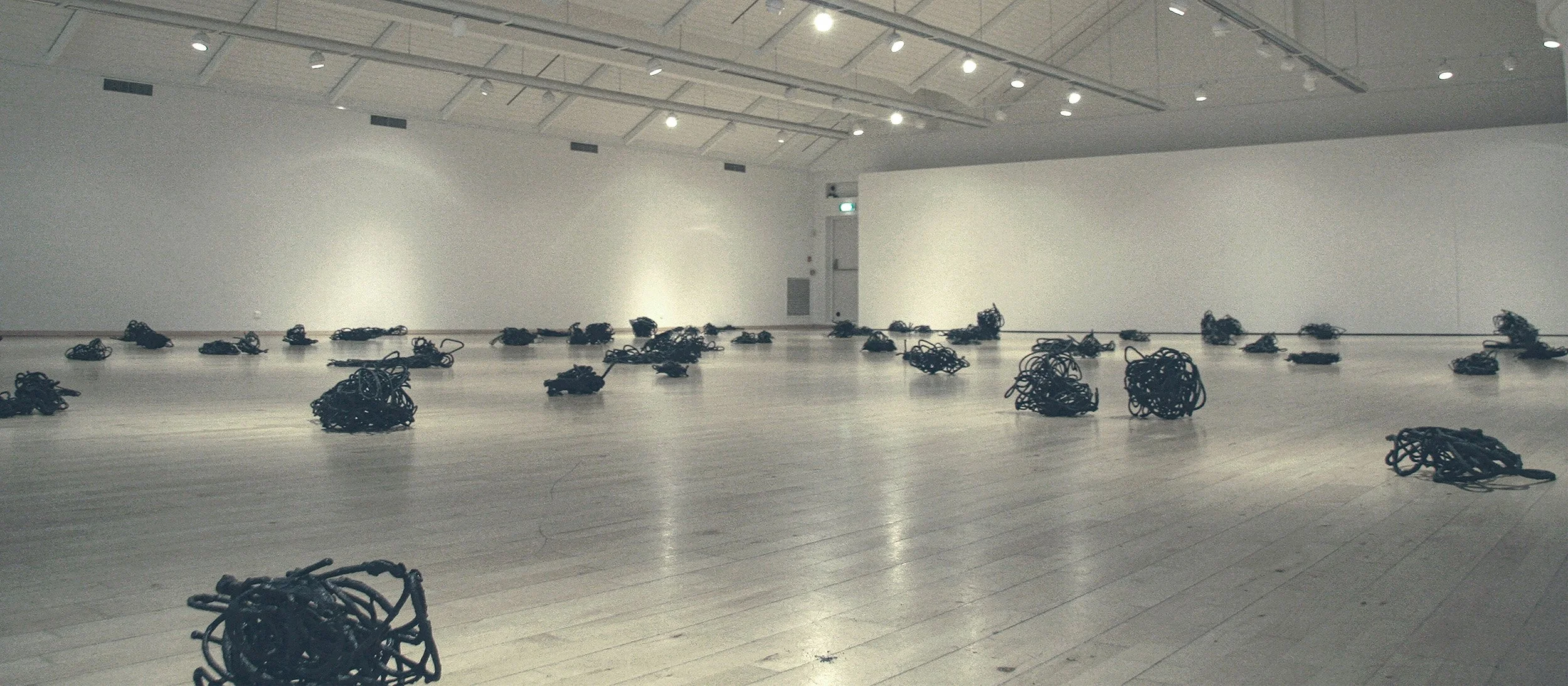
Rhapsody Floor Horizon, 2008. 85 drawing episodes; graphite and paper-coated rope; dimensions and placement vary; 3,000-square-foot space. Hafnarborg, Hafnarfjörður, Iceland.
Instead of focusing on the individual mark, Rhapsody concentrates on the accumulation of marks occurring over a specific time frame. Functioning as drawing units, these marking episodes collectively construct a drawing either sequentially on the wall, dispersed on the floor or even stacked in layers. Related works such as Scroll, Intervals, and Cursive concentrate on a wrist instead of an arm/shoulder manufactured gesture.
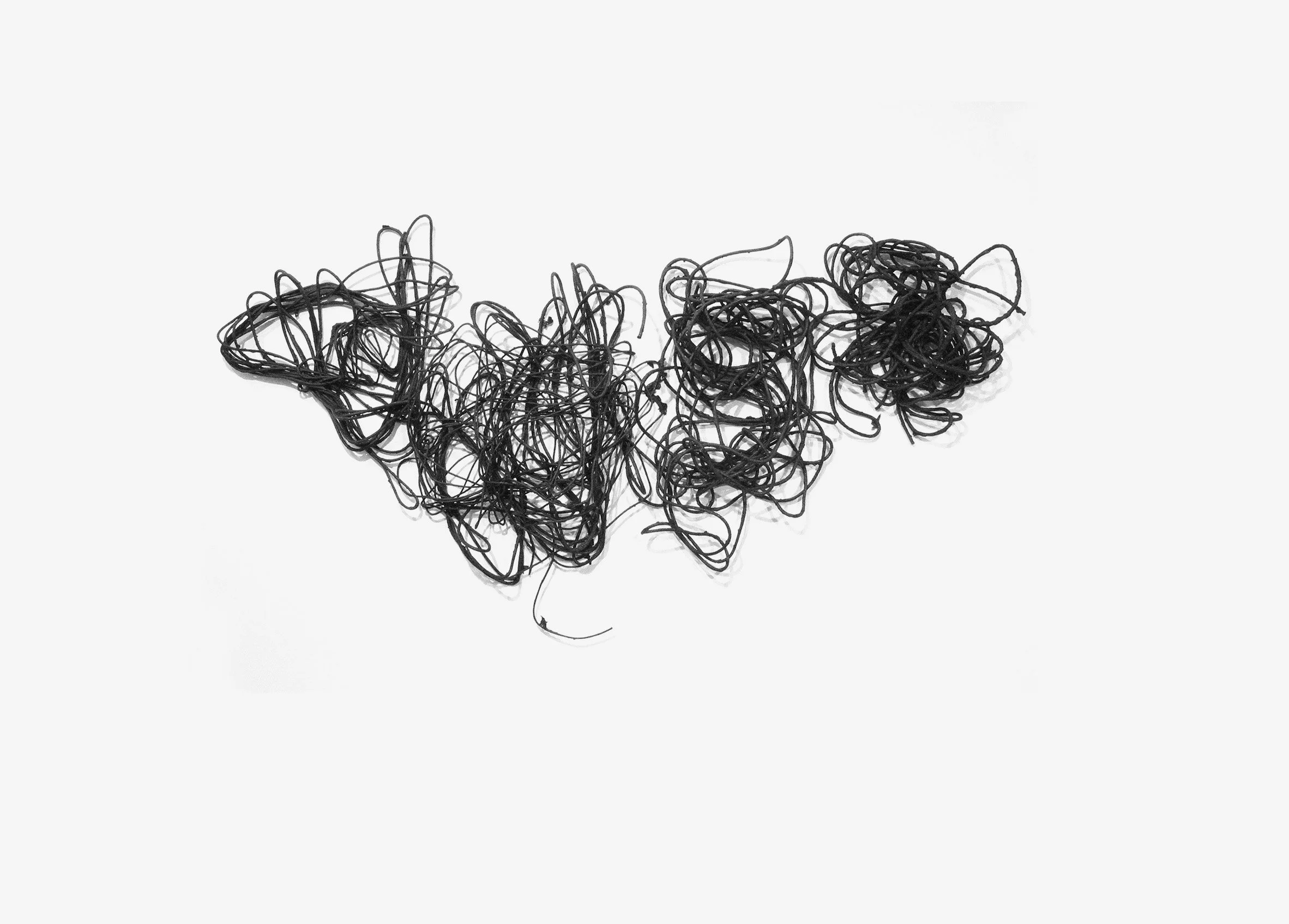
Rhapsody Wall Horizontal 308, 2008. Paper and graphite-coated rope, 37 x 68 x 7.5”. Private collection, New York City.

Rhapsody Wall Vertical 208, 2008. Graphite and paper on rope, 58 x 26 x 12”. Private collection, St. Helena, California.

Scroll, 2011. Graphite and paper-coated rope, 96 x 60 x 8”. Allen Memorial Art Museum, Oberlin College, Ohio.
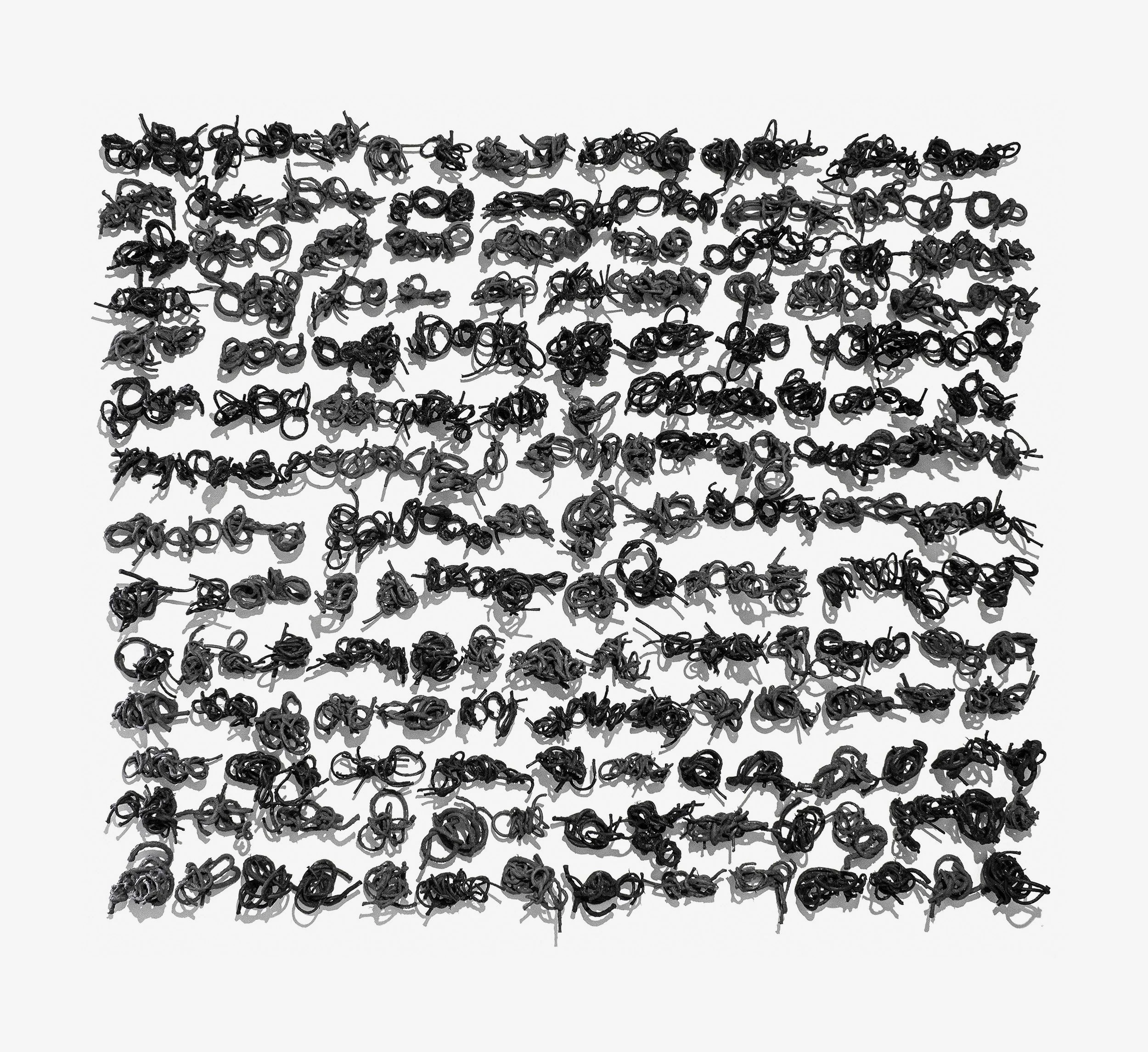
Cursive 114, 2014. Graphite and paper-coated rope, 60 x 75 x 7”; dimensions vary.
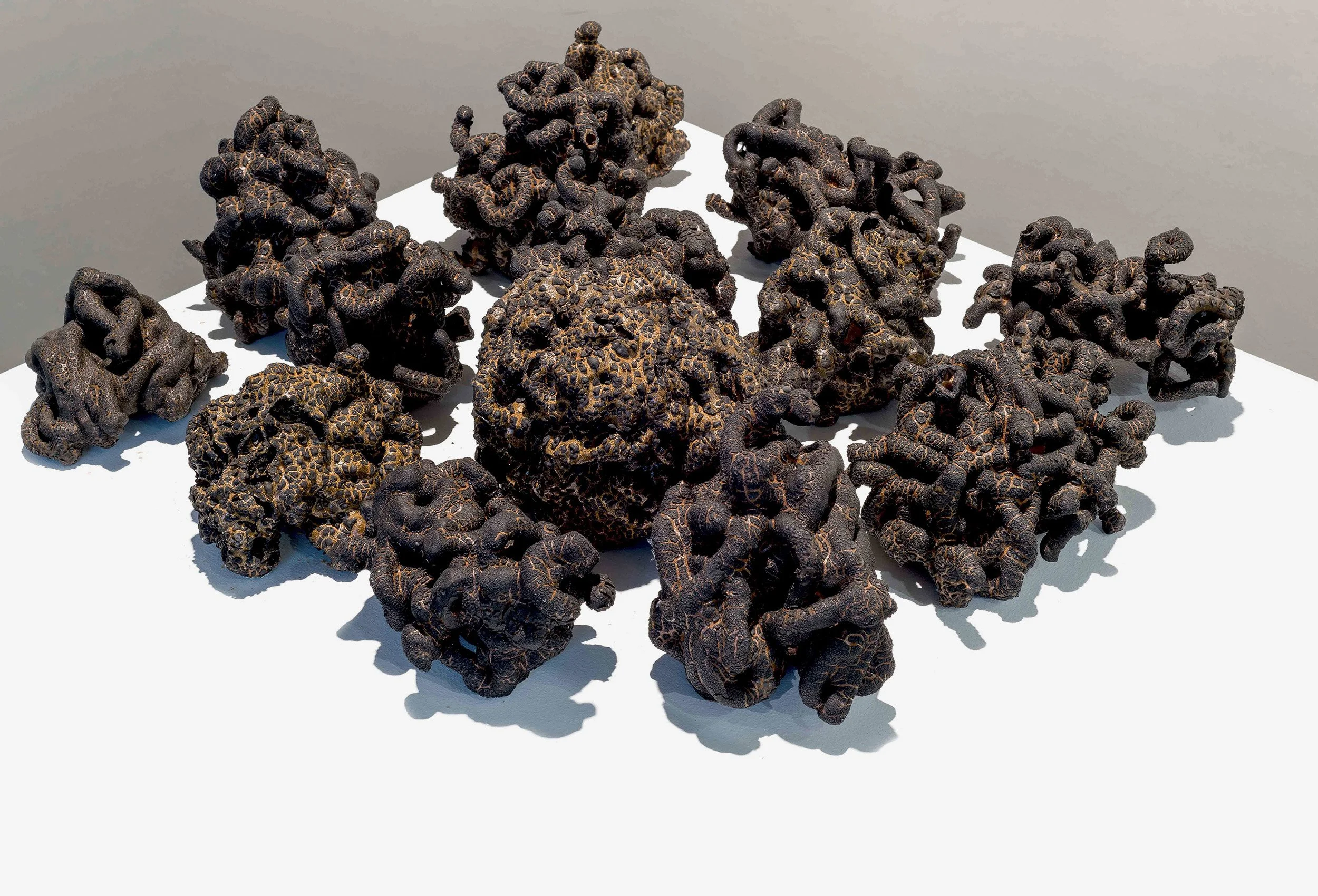
Intervals, 2012–13. An episodic drawing collaboration with Jon McMillan. 25/30 glazed earthenware marking episodes; dimensions variable.
The Dimensional Drawing Project
In 2004 Munson-Williams-Proctor Arts Institute Museum of Art was hosting an exhibition of my work but needed additional assistance with the installation to open the show on time. I suggested to the curator, Mary Murray, that she ask sculpture students studying at the institute to help with the installation since this work had been designed for someone other than myself to install. A blend of drawing and sculpture, these new works were in essence drawing kits with instructions that allowed the preparator varying degrees of freedom in deciding how the piece would be installed and in turn the preparator would become invested in the process and its outcome. The student response was overwhelmingly positive not only in mounting the exhibition but also with their attendance at both the lecture and following reception. As an artist and educator, whose primary focus is drawing, I realized developing this experience into a mobile project could be a powerful tool in the understanding and teaching of drawing to students both in studio programs as well as in related fields. Creating an exhibition through collaboration between student teams and engaged faculty as well as myself has proven to be an inspiring platform for teaching drawing from an unconventional perspective.
My second collaboration with a composer was with Bruce Roter as an addition to my Dimensional Drawing Project at the College of St. Rose in Albany, New York in 2011.
Pattern Play II: exploring process and collaboration through drawing, Herron School of Art and Design, Indianapolis, Indiana; 2016
Creighton Michael: PLANE DRAWING, The Baker Center for the Arts, Muhlenberg College, Allentown, Pennsylvania; 2008 catalogue essay by Lilly Wei)
SQUIGGLElinear, Center for the Arts, Towson University, Baltimore, MD; 2007 travels to the Delaware Center for the Contemporary Arts, Wilmington, Delaware; 2008
Pattern Play II: exploring process and collaboration through drawing, Clara M. Eagle Gallery, Murray State University, Murray Kentucky; 2015-16. MSU Link. Youtube Link.
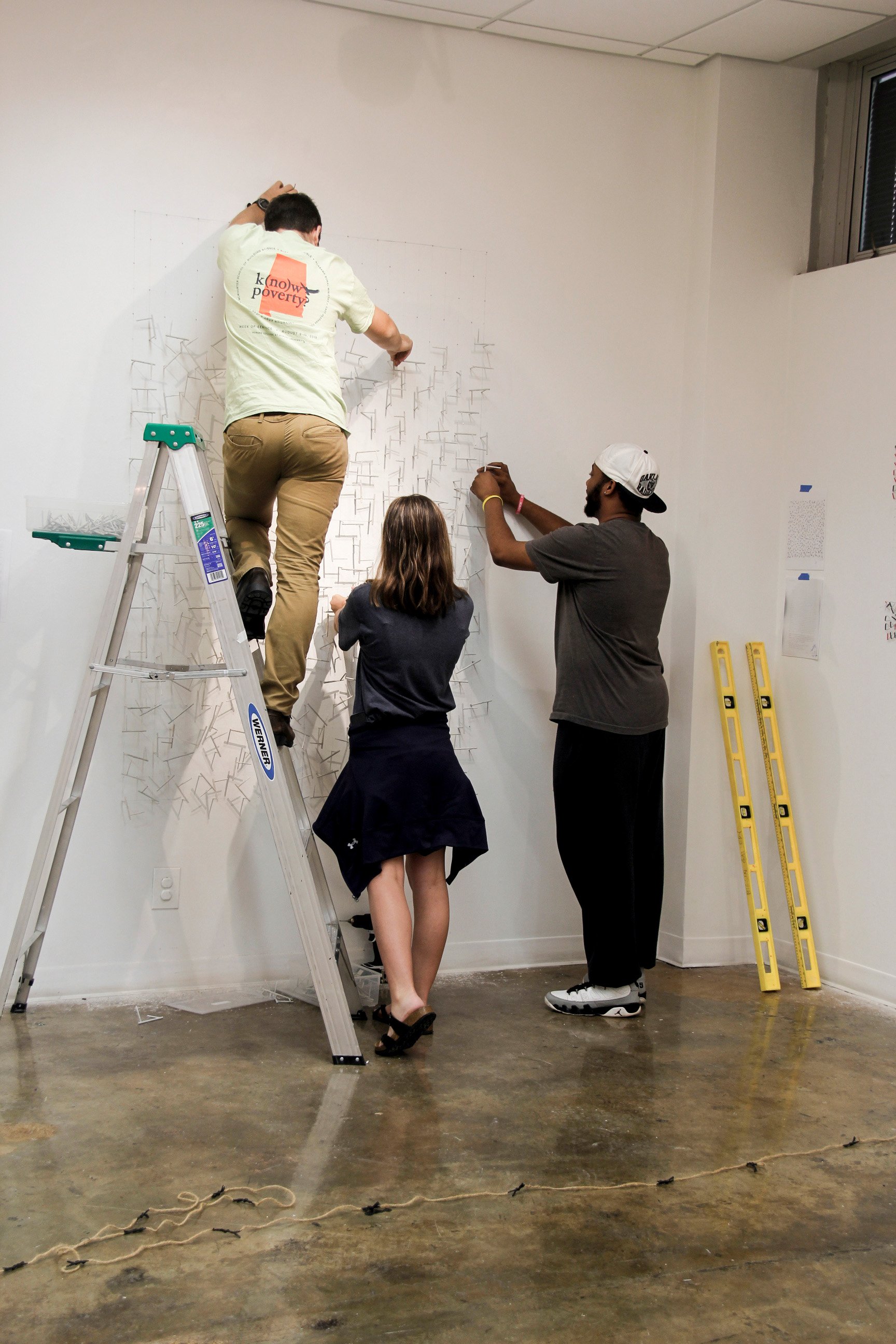
Pattern Play II: exploring process and collaboration through drawing, Biggin Gallery, Auburn University, Auburn, Alabama; 2015
CIPHER, NCC Art Gallery, Norwalk Community College, Norwalk, Connecticut; 2008
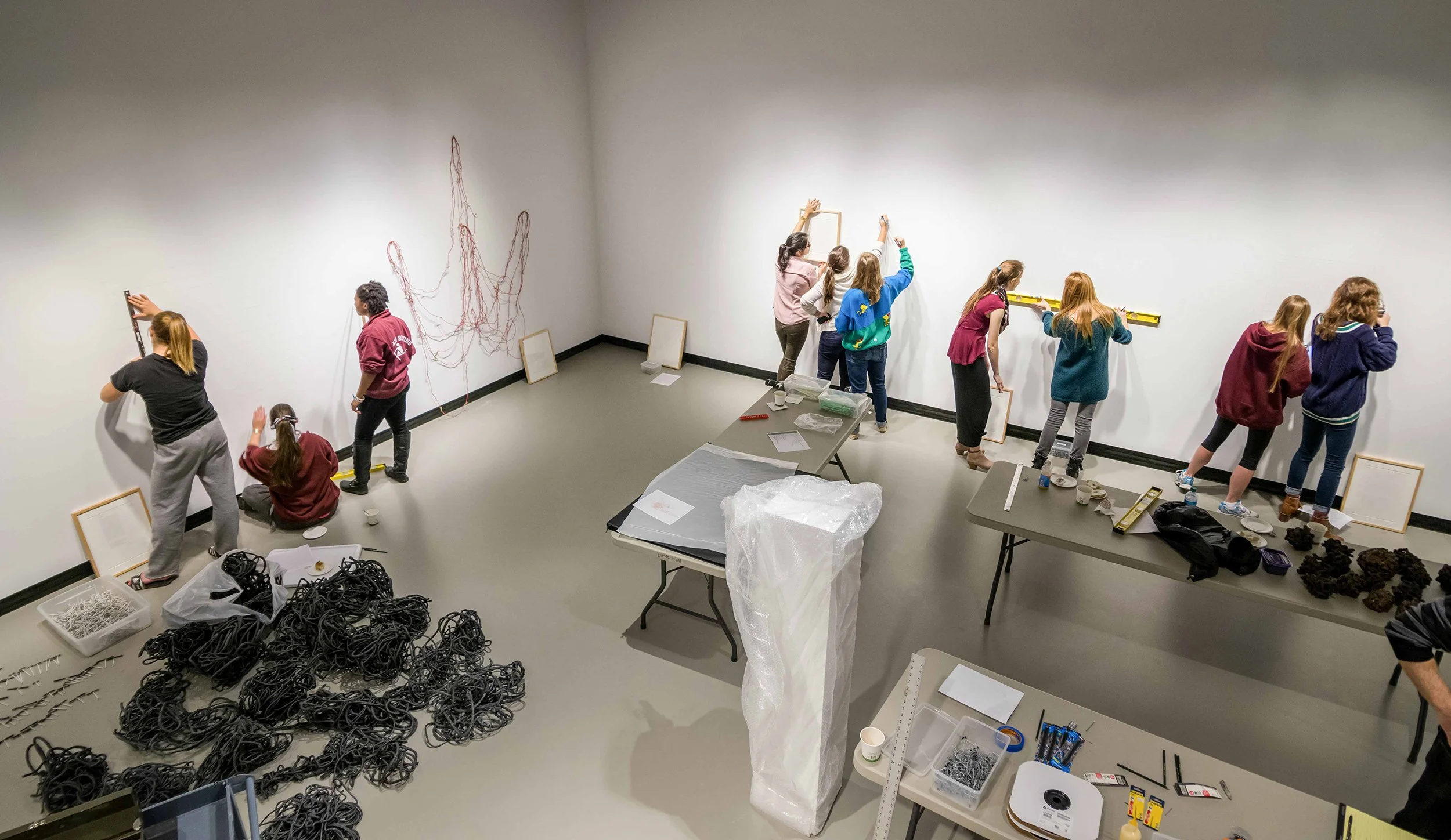
Pattern Play: exploring process and collaboration through drawing, Clifford Gallery, Colgate University, Hamilton, New York; 2013-14. Gallery Link.
Pattern Play: exploring process and collaboration through drawing, Clifford Gallery, Colgate University, Hamilton, New York; 2013-14. Gallery Link.
Tangible Marking: The Dimensional Drawings of Creighton Michael, Esther Massry Gallery, The College of Saint Rose, Albany, New York: 2010-11 (includes CONSTRUCT a collaboration with composer, Bruce Roter

Expanded Drawing, du Pont Gallery, University of Mary Washington, Fredericksburg, Virginia; 2012
Trace is composed of the same graphite and paper mixture that coats the rope structure in the Squiggle and Rhapsody series as well as other fiber-based works. Trace mimics the drawing process through repetition, building layer upon layer, creating a stratum of compressed marking episodes that maintain the intimacy of drawing with the physicality of sculpture.
Trace 312, 2012. Acrylic, paper, and graphite, 38 x 48 x .25”. Private collection, St. Helena, California.
Trace 913, 2013. Acrylic, paper, and graphite, 28 1/2 x 27 x 3/8”.
Split Infinitive, and Etch that followed, combine previous drawing activity with segments from partially erased marking episodes building multiple marking histories into a complex composite of three-dimensional drawing. The medium,100 % cotton rope coated in a graphite and paper emulsion, is itself a transformation of conventional drawing materials distilled into three-dimensional gestures.
Split-Infinitive 117, 2017. Graphite-coated rope with wire connectors, 20 x 16 x 14”.
Split-Infinitive 717, 2017. Graphite-coated rope with wire connectors, 17.5 x 23 x 12”.
With the outbreak of Covid in 2020, I turned my attention to cataloging and archiving my fifty-year practice as well as focusing on new explorations with digital and analog techniques in drawing.
Etch 219, 2019. Graphite and paper-coated rope with wire connectors, 33 x 16 x 9.5”.
Etch 519, 2019. Graphite and paper-coated rope with wire connectors, 21 x 15 x 10”.